Site life…spring Somewhere. You decide where. Waking up. Not my favourite thing, but seeing beams of sunlight pierce through the holes in the curtains and hearing people shuffling about outside makes me sit up faster than usual. It’s warm in the trailer… I hop out of bed and open the wonky door, as usual the dog’s push past, going straight into sniff everything mode. I look out, there is a blackened kettle atop of a small fire… Neighbours are busy already. I didn’t want to boil my kettle with gas, so I shouted quietly, any tea? The answer was no. Brandy coffee? That will do nicely. my head weighed nothing and i collapse back into my pit. Within seconds a cup appeared on my doorstep. Got no sugar.. A voice said. I do. I replied. Top cupboard. A pair of black feet appeared, followed by a pair of skinny legs and a crusty t shirt with a dread head on top. A roll up stuck to its lips.. Nice day, I began.. How would you know? Said the dread. I can feel it in my bones I said. I see. And I can smell it the air, I beamed as he tipped enough sugar into my hand. I dropped it in the coffee and gave it a quick stir with a pencil. Cheers, cu in a bit. Yeah, I expect you will he droned, turning and shuffling out, bag of sugar in hand… And bring the sugar back…. Knowing it was unlikely to see it again, I added, well save me a bit..I lit the last bit of spliff that I had left from the night before, with the lighter I couldn’t find last night, but there it was, next to my pillow. I opened the curtain a little letting fresh spring beams in, polluting them immediately with the smoke, I lay back watching the swirls drifting and twisting towards the door, the first of many flies flew in, I dragged myself up to pull the makeshift curtain across taking a step out onto the now dry mud, it felt good underfoot, warm and sponge. A cockrel ran past at speed, followed by another, much flapping and squawking, they didn’t get on. One lived at the top of the green lane that was our temporary home, the other at the bottom, but I guess even cockrels enjoy a bit of mooching about, despite the risks.. The dogs lay dotted about, looking on indifferently, it was their first bit of sun for a while, they were making the most of it, some opting for the soft earth some taking advantage of slightly worse for wear weathered sofas and armchairs. One scraggy little pup had dragged a smelly old blanket under the doorway of a bus, lying half in and half out of the sun, a good thing as the mounting numbers of flies that will come as a result of the humidity when the land dries, all made a beeline, well, a flyline for said grubby object. I looked up the track, the assortment of coloured old lorries, bland little trailers separate with various tarp covered piles of tat, the odd engine, rag n bone, wheels and a mountain of tyres left by previous tenants. Much of this lying in the shadow of a double decker, some punky reggae music drifting down, in the opposite direction, stood a fairly battered range rover, its front end up on jacks. A huge almost clean chrome trailer, with a a homemade trailer board hanging lop sided, in front a flatbed Bedford army truck heaped with cables motors and other bits of broken trucks. More music, and a smouldering fire surrounded by my neighbours, blackened faces on shaven heads, holey t shirts with barely readable slogans, skinny arms poking out, ragged army trousers and boots, two or three bigger people with flowing dreads, chunky tattooed arms and heads full of silver, a group of skinny girls in summery dresses and big boots squidged together with one or two stubborn lurchers, all chattering incessantly, a group of toddlers ran up and down with a homemade go cart, faces still covered in breakfast. Further on still stood a couple of bow tops, a bender and a bug old cart horse munching fresh grass, swishing its tail. Another small fire with a huge cast iron kettle hung on a hook above the gently chuffing smoke, one old flat capped man sat down on a log, his cockrel had returned and sat opposite, next to the goat. A police helicopter flew over shattering the peace for a moment, as everyone stuck two fingers in the air at it.. Then it was nothing more than a a distant whirring, the birdsong and music returning, nice.i caught sight of silver cans being passed, as I heard the prkcushzzzz sound of one being opened I made my way to the group, I had a good feeling about today…
Today is Romany holocaust memorial day, yet ask most lifelong anti-racists what the significance of August 2nd is, and they will be puzzled. For our history, just like our plight, remains one of Europe’s dirty secrets. So come with me, if you will, on a journey into the past of Europe’s 12 million Romany people because we desperately need your help to secure a better future. Because history does not always exactly repeat itself, but in 2021 it is starting to rhyme.
On this day, in 1944, 4,300 Romanies were murdered at the Auschwitz-Birkenau concentration camp. They were taken during the night from their barracks to the gas chamber by SS guards. The mass killing was a reprisal on the community who led a desperate uprising at the death camp. Just months earlier on May 16th Romany prisoners of the so-called Zigeunerlager (Gypsy camp) having heard of the imminent liquidation of the camp, stood up against the Nazi guards armed with only hammers, pickaxes and shovels. As a result of their defiance, no Roma died in the gas chambers on that day. The Romany revolt against the Nazis is the only recorded uprising in Auschwitz and is now commemorated as Romani Resistance Day.
We still do not know how many of us died in the holocaust. Unlike the Jewish community many of our ancestors could not read or write, so few independent records were kept. Estimates range from 500,000 to 1,5 million people, their lives and stories are often lost within German statistics of those “remaining to be liquidated.” Like the Jewish community we were the only other racial minority specifically subjected to the Nazi final solution and a similar percentage of the Romany and Jewish community was eradicated. But there the parallels end, because what the intervening decades have taught us is that some inequalities are sadly far more equal than others.
So today we will weep for those we lost, but tomorrow we must again pick up the shovels. Across Europe a mudslide of racist violence is once again engulfing our people. From Hungary to the UK, right-wing governments are once again scapegoating our people and the results can be lethal.
In the Czech Republic, Romany man Stanislav Tomáš died in Teplice on June 19, 2021, after a Czech police officer knelt on his neck for six minutes. In images comparable to the murder of George Floyd in the US, the video went viral, prompting Romanies across Europe to protest police violence.
The Czech Republic authorities deny any wrongdoing and the police were praised by the interior minister for their good work. After the Council of Europe called for an independent investigation, the Czech president said he had no reason to doubt the results of the internal investigation, which found the police officers’ behaviour to be correct.
In New York, Berlin, Brussels, Glasgow, London, Vienna and in countless cities across Eastern Europe where Romany populations are big and growing, Romanies are demanding justice for Stanislav and themselves. Directly inspired by the Black Lives Matter movement a Roma Lives Matter movement has seen thousands of Romany people demand better treatment on the streets.
For many of us, the end of the holocaust did not lead to a turning point in our treatment and life chances. Those that had survived the Nazis were soon forcibly settled and assimilated into urban deprivation by Stalinist regimes. In recent decades, the forced sterilisation of Romany women, poverty and over-representation in state care and special schools for Romany kids and deeply ingrained prejudice has kept us moving. Such racism has led to a huge wave of Romany migration to western Europe. This has led to a doubling of the British Gypsy, Roma and Traveller population to at least 600,000 people.
But Britain is no safe haven. The hostile environment experienced by Britain’s Gypsy, Roma and Traveller community for over 500 years has recently been cranked up. Priti Patel’s Police, Crime, Sentencing and Courts Bill not only limits the right to protest, but also seeks to completely outlaw nomadic Gypsy and Traveller culture across the UK. If passed it will:
Entirely eradicate nomadic life in Britain,
Give police the power to seize Gypsy and Traveller homes
Fine Gypsies and Travellers up to £2500
AND imprison those needing to follow a nomadic way of life because of a lack of safe legal stopping places
So, on July 7th over 1000 community members gathered in the shadow of the statues of Mahatma Gandhi, Nelson Mandela and suffragette Millicent Fawcett in Parliament Square to kickstart the Drive 2 Survive campaign that will roll from Westminster to Appleby Fair in August (the world’s largest Gypsy horse fair) in Cumbria to the Conservative Party Conference in Manchester in October 2021. Much as Gandhi, Mandela and Fawcett used direct action to fight for equality, Gypsy and Traveller community members will resist the outlawing of our cultures. Our communities have unified to fight the bill, but we desperately need your help to stop it.
‘As nomadic people that have roamed the lands we have lived on for our whole recorded history, to suddenly be told our way of life has no place in society is totally wrong and hurtful’ says Irish Traveller activist Chris McDonagh.
‘We all live in a country that is supposedly proud of its acceptance and equality for ALL ethnicities and minorities, but we now see this is a lie. We are people and we deserve to live our lives as we always have. We deserve to exist.’
The Drive 2 Survive Campaign first aim is the scrapping of part 4 of the Bill that creates a criminal law of trespass and dramatically increases police powers over anyone residing on land that they do not have permission to be on. We believe that the draconian powers within the 1994 Criminal Justice and Public Order Act that already lock nomadic Gypsies and Travellers into a cycle of trespass and eviction do not need strengthening but repealing.
Priti Patel cannot ignore the fact that police powers are already too excessive. It’s not just Gypsies, Roma and Travellers that are resisting these new powers, but representatives from the National Police Chiefs Council. In evidence to the committee stage of the Police Bill, the community and the police were united in calling for a better way of resolving the conflict around a lack of stopping places
The community takes the threat of the new legislation so seriously that it has organised the first Romani Kris, or council of elders in decades to debate and decide a unified response to Patel’s Bill at Appleby. Hereditary Appleby Fair organiser Billy Welch sees a direct parallel with the state violence Romany populations were subjected to before the holocaust, because before the death camps came the outlawing of nomadic life across the Third Reich.
“The people I represent are anxious about these proposals and with good reason. They are reminiscent of Nazi Germany in the 1930s, and the start of the process of ethnic cleansing in which Gypsies were forced off the road by fines and imprisonment. Their horses and vehicles were confiscated, which eventually led to them being sent to death camps or murdered on the side of the road. There are still many Gypsies alive who lost their families in that holocaust, and they have not forgotten – this is how it began. All of what was done them was legal in the eyes of the Nazis, but history teaches us clearly that just because something is legal, doesn’t make it right.” – Billy Welch
This summer we will show the Conservative Party that we will not go quietly into the history books, in fact, we will not be going at all.
To show your solidarity with the Drive 2 Survive Campaign:
Come to Appleby Horse Fair in Cumbria between August 12th and 15th.
Attend the National Drive 2 Survive Rally at the time of the Tory Conference in Piccadilly Gardens, Manchester at 1pm on Saturday October 2nd 2021.
Posted in.|Taggedgypsy, killthebill, law, romany, travellers|Comments Off on We will not go quietly into the history books. We will not be going at all.
WHITE people with dreadlocks are not facing as much discrimination as they would ideally like, it has emerged.
Matted hair owners claim that other than being broadly defined as ‘crusties’ and ‘trustafarians’ they were going largely unnoticed by mainstream society.
25-year-old Brighton resident Tom Logan, who prefers to be called Boz, said: “I can’t remember the last time someone shouted something in the street, and even then it was something non-commital like ‘have a bath mate’.
“Can’t they see that I don’t subscribe to their stupid materialist values, and am in fact a threat to the status quo?
“These dreads took years to grow, they’re bloody itchy, and right now I’m feeling like it was all a waste of time.”
Dreadlocked Emma Bradford, aka Trouser, said: “I’ve been able to get a series of jobs, nothing fancy admittedly and mostly in organic cafes but still I’m consistently being treated like a normal, unremarkable person.
“Which I’m not, obviously, because I’ve got unusual hair and a rusty van with pictures of animals on it. Also I can stay upright on a unicycle for up to three minutes at a time.”
She added: “Someone needs to oppress me. Maybe they could bring back punks just so they can chase us around town centres.
Today the word on the street is ‘Occupy’. This is how we used to do it in the 90’s…
Imagine 5000 people being taken across London by underground to a mystery location and then transforming a motorway into a sand pit, a dance floor, a forest. Imagine radical ecologists joining forces with sacked dockers and occupying Liverpool docks. Imagine Trafalgar Square metamorphosed into London’s largest rave while under siege from 3000 unhappy riot police. Stop imagining and watc h this film. YOU WILL BE INSPIRED.
May 1995, London, England. A small group of people decide to organise an illegal street party in Camden, a part of the city renowned for its consumerism and incessant traffic. The final location is kept secret, because they know that the state and business will not be amused. Reclaim the Streets! is born, a cocktail of raging love, revolutionary carnival, art and anarchy. Since then the clandestine street parties have erupted all over the world. From Hull to Sydney, Lyon to Tel Aviv, Vancouver to Valencia, people are taking back their streets. And this is only the beginning.
This film, a 2012 re-edit of the original, made from over a hundred hours of footage from 13 film-makers, and brought up to date with a recent expose of cop infiltration, tells the story of reclaim the Streets from its origins in London to the Global Street Party in May 1998 when 30 cities simultaneously joined in the fun.
‘Ultimately it is in the streets that power must be dissolved: for the streets where daily life is endured, suffered and eroded, and where power is confronted and fought, must be turned into the domain where daily life is enjoyed, created and nourished.’
Preventing cheap politics from sinking the planet… Alan discusses his pamphlet – a challenge to all who champion a visionary ‘New Deal’.
Preventing cheap politics from sinking the planet… Alan discusses his pamphlet – a challenge to all who champion a visionary ‘New Deal’.
This is a challenge to all of us who champion the case for a visionary Green New Deal. It insists on a timescale that cuts carbon emissions in half, within the current decade; demands radical shifts into a more ‘circular’ economics, putting back more than we take out; and a vision that runs beyond obsessions with individual technologies. Instead, Alan focuses on the ‘systems’ that tomorrow’s inclusive security must be built around.
“As ever, Alan brings a big picture vision wrapped up in glittering examples of what transformation means in practice. From communities, to cities to whole countries, there is no wrong place to start, no part of the economy that doesn’t need to be turned upside down and rethought.” Clive Lewis MP
Alan Simpson was MP for Nottingham South before leaving to work on climate issues. He was advisor on sustainable economics to John McDonnell when he was Shadow Chancellor. Alan still dreams of saving the planet!
This event was streamed live via Zoom on July 19 2021.
Magnum photographers discuss alternative approaches to communicating climate change
In this study of new photographic approaches to issues of climate change, Magnum photographers Sim Chi Yin, Cristina de Middel and Jonas Bendiksen speak to writer Georgina Collins about their practice. Alongside this, Toby Smith from the charity Climate Visuals shares strategies on revolutionizing how we communicate current environmental crises.
Jonas Bendiksen Bangladesh. Genduram in the Gaibandha district. 2010. Flooded village. The three villagers standing / sitting by jute on small ‘island’: Rafiqul Islam (sitting on jute, left), Mohammad Delwar Hoss
In the summer of 2019 unprecedented temperatures were experienced across Northern Europe, with at least 12 countries breaking national heat records. July 2019 was the hottest month on earth since temperature records began in 1880. This was, and is, indicative of the growing disaster the planet is facing in the form of climate change. World Weather Attribution found that there was an extremely low probability of these temperatures being reached (for instance in France less than about once every 1000 years) without climate change. Climate change made this extreme weather around 100 times more likely. Put in these terms, the summer of 2019 sounds apocalyptic- and in many ways it was. The European Forest Fire Information System found that in 2019 1,300 square miles of continental Europe were burned (15% more than the decades annual average), but the vast majority of the photography that we saw told a different story. Beach days, sunbathing and icecreams predominantly featured in photographs of the summer.
“It’s this cynicism that they hope photography can help overcome in order to build our collective investment in reducing environmental harm.”
The role and responsibility that photographers themselves have when photographing events related to the climate crisis has been subject to increased attention in recent years. Photography is a powerful visual medium that can be used to educate, raise awareness and inspire action, and as such there is a strong argument that this comes with an implicit responsibility about the representations of an issue being made to the public. Visual storytelling can shift public perception and behaviours, which in turn influences national and international responses to the crisis. Climate Visuals is a non-profit built around this relationship between photography and social action; focused on changing the type of imagery used in relation to the climate crisis, so that it is not just “illustrative but truly impactful and inspires change,” as project lead Toby Smith states. The group is founded in research in social science; they use evidence gathered from focus groups in Europe and the USA to examine the emotional responses to different photographic depictions of the climate crisis. Smith says they want to see a more compelling and diverse visual language around climate change: less “polar bears, factories and glaciers… all of which have the really neat trick of signifying climate change, but still producing a large amount of cynicism and inactivity”. It’s this cynicism that they hope photography can help overcome in order to build our collective investment in reducing environmental harm.Jonas Bendiksen China. Qinghai province. 2009. In the Yellow Rivers headwaters area. Just outside Hua Shi Xia, a settlement for resettled nomads. The pictured family were resettled from the surrounding area around (…)
Jonas Bendiksen Tajikstan. 2009. In the village of Shohi Safed by the Zerafshan river in the Zerafshan valley. Muholol “General” Ahmedov (73), picking currants from a tree. Next to him are two water irrigation pip (…)
Jonas Bendiksen China. Qinghai province. 2009. In the Yellow Rivers headwaters area, about 40m drive from Madoi town, towards Yushu. Sand dunes show the increasing desertification of the Tibetan plateau, with shal (…)
It is perhaps because the climate crisis has presented a new challenge to practitioners (how do you go about capturing an existential threat, moving at literally glacial speed, in a single frame?) that imagery has often felt reductive in the face of a challenge on the scale of the climate crisis. Magnum photographer Cristina de Middel, who covered the 2019 wildfires in Brazil, describes exactly this: “The drama and the destruction that was happening was hard to capture and express with just images of flames and burnt pieces of the jungle. The scale of everything was overwhelming and by framing that reality, and deciding which piece of it would become a picture, I was actually losing the magnitude of it”.Cristina de Middel The Xavante tribe is known to be aggressive and a warrior society. They call themselves “the invisibles”. Fire plays an important role in their traditions. They use if for hunting and also to keep (…)
Cristina de Middel The fazenda of Sidnei Hübner is just 800 acres, a small one for the area. In the beginning of Augusta fire burnt 2/3 of his area right after the corn harvest. The fire started at a some neighbours (…)
Cristina de Middel Entrance of the fazenda Flamboyant, a 800 acre propertu focused in corn and soy production. The owner, Sidnei Hübner arrived from the South 40 years ago looking for cheaper land to cultivate. In (…)
“I think it depends on what you expect photography to do or what you expect of the photographer,” says Sim Chi Yin in reference to the challenges posed by photographing the climate crisis. “I think this is a deeper question about whether photography and photographers are expected to be advocates and activists as well,” she continues. “There are things that may translate photographically into climate change and some things that don’t”. Sim has been working on her project Shifting Sands, documenting the social and environmental cost of the land reclamation industry in East and Southeast Asia. Previously taking an ‘infrastructural gaze’, shot at ground level, capturing the people and places affected, she has since adopted a birds-eye view, producing strikingly beautiful other-wordly landscape photography. It’s not uncommon to hear criticism of photography, particularly in the realm of editorial, for making terrible things look too beautiful. This is an all too familiar conundrum for Smith in his work at Climate Visuals: “I spend a lot of my time arguing with the media about social science but the other side is that I spend a lot of time arguing with social scientists about the subjective qualities of photography,” he says.NEWSROOMA Mirage of Luxury Built on SandSim Chi YinSim Chi Yin Singapore. Tuas. 2017. From “Shifting Sands”, 2017 – on-going. Land reclamation works are on-going at this area of Tuas, Singapore’s westernmost area where a new massive container port — the w (…)
Sim Chi Yin Tractors plough through piles of sand which have been deposited by sand barges at the Forest City development — a joint venture between a China developer with the state government and Sultan of Joh (…)
In essence, though accurate and impactful depictions of the climate crisis are the goal, the photos need to be published if you’re going to achieve that, and the pictures have to be good or that’s not going to happen. For Sim Chi Yin, the beauty of her Shifting Sands images were an entirely deliberate move away from the more ‘ditactic heavy-handed approach’ she once took; here, the aestheticization of a challenging topic is a strategy to encourage on-going engagement in a difficult conversation.Vietnam. Mekong River. 2017. Ha Thi Be, 67, poses for a portrait with the two young grandsons who lived with her in this ancestral home, Ha Duy Phuc, 11, and Ha Trung Kien, 4. The children have rar (…)
Sim Chi Yin Vietnam. Phu Thuan B commune. 2017. Ms Lam Thi Kim Muoi, 43, poses for a portrait in her family’s ancestral house abandoned a year ago (2016) after riverbank erosion snapped part of it off into th (…)
There is, for obvious reasons, an excess of what might be referred to as ‘disaster photography’ in coverage of the climate crisis. The aesthetic properties of these images ‘sell’ but, according to Climate Visuals research, don’t create a meaningful, or – perhaps more accurately – an actionable, response in the viewer. The Global South has already suffered a disproportionate number of climate disasters, simply because populations and ecosystems in tropical, higher-latitude regions experience the worst effects of rising global temperatures. As a result, you’d be forgiven as a consumer of photography for thinking that climate change wasn’t affecting Western Europe. This echoes the experience of de Middel: “I think we are still in a stage where environmental issues are perceived as something exotic and distant, even if they are not. Despite the frequent vivid reminders of the seriousness of the situation, the threat sounds distant and that makes the sense of urgency very difficult to convey”. Many people don’t relate to these images beyond the shock and awe of the moment, because it doesn’t resonate with their own demographic construct. This in turn, has resulted in the othering of communities in the Global South as they are continually represented as victims, often by foreign Western photographers, as a way to capture the climate crisis in a way that’s seen as visually appealing. Rarely do we see the photography of practitioners with lived experience of climate disasters in the Global South, and rarely do Western photographers’ cameras turn to document the effect of climate change closer to home.ARTS & CULTUREBoa Noite PovoCristina de MiddelCristina de Middel and Bruno Morais From the project ‘Boa Noite Povo’. In 2017, when we moved to the Mata Atlántica jungle in Brazil, and started cohabiting with the frantic wildlife of the area, we decided to start exploring the exi (…)
Cristina de Middel and Bruno Morais From the project ‘Boa Noite Povo’. Boa Noite Povo is a mix of archival imagery, directed animal action, night photography and plastic intervention of ephemeral pieces that show the complexity of th (…)
This, at least in part, can be attributed to a general desire for simple narratives when taking on an issue as huge and amorphous as the climate crisis. And, in a parallel and more practical sense, the causes and impacts of climate change are more compelling and cinematic than, say, the solutions to the climate crisis. So, reaching Net Zero – achieving an overall balance between emissions produced and emissions taken out of the atmosphere – has the potential, in Smith’s own words, “to be a really boring photographic essay”. There is however, an “extremely powerful” way to communicate the issue, by combining images of disaster with images of solutions and action.NEWSROOMFuture Proofing Life on EarthJonas BendiksenJonas Bendiksen Bangladesh. Genduram in the Gaibandha district. 2010. Flooded village. The three villagers standing / sitting by jute on small ‘island’: Rafiqul Islam (sitting on jute, left), Mohammad Delwar Hoss (…)
But this in itself presents a challenge, and gets to the heart of the problem of documenting the climate crisis in photography; how can photographers tell more nuanced and innovative stories within their relatively narrow medium? Jonas Bendiksen, who documented Bangladeshi communities experiencing chronic flooding, says that “photography has a tendency to oversimplify; it’s not the easiest medium to formulate a complex thought process; it tends to rely on ‘good’ versus ‘bad’ and be less focused on the complexities of things”. He’s increasingly interested in the ‘grey zones’, for instance how photography of Western consumerism also provides an important perspective on the climate crisis, but is frustrated by limitations of the platforms that are available. There’s an increasing pressure, driven by social media, for single images or a couple of slides to have an impact, to be easily-digestible. Climate change, particularly its effect on the Global North, will not reveal itself so it can be fitted neatly onto social media feeds. The commodification of environmental images, which we could describe as the photograph-social media industrial complex, also leads to an oversaturation of images, resulting in just the apathy that the Climate Visuals is endeavouring to avoid.THEORY & PRACTICEMost People Were SilentSim Chi YinJonas Bendiksen Bangladesh. Padmapukur. 2009. On the ‘char’ (silt island) of Padmapukur, in the Ganges delta. Hurricane Aila destroyed the dikes, thus causing daily flooding of the communities. Most of the village (…)
Some are already looking to overcome these limiting factors, like de Middel. “As a communicator, I find it interesting to explore new ways of presenting issues whose narratives are already exhausted and who suffer from over-reporting,” she says, “I believe it is part of the job to keep the audience interested and curious to know more”. Sim Chi Yin says “I think it’s no longer enough just to make the pictures and put it through an editorial channel” — where it is consumed for a day, and then forgotten about. As Sim grew increasingly frustrated with the limits of single image photography, she experimented with exhibition installations, performance lectures, and for her Shifting Sands project, a VR installation that has yet to be completed due to lack of funding. She says, “I think we live in a different time, and this period of information and imagery-saturation needs different types of visual strategies for storytelling”.Sim Chi Yin Malaysia. 2017. From “Shifting Sands”, 2017- on-going. A family takes a walk and goes fishing in an area in southern Malaysia now covered with giant sand dunes. The Danga Bay area is earmarked for (…)License |
Smith makes it clear that it’s not just the photographers and content generators, who sit at the wide bottom of the ‘pyramid’ of the photography industry, who can play a role in shifting public perceptions of the climate crisis. It’s also the agency, distribution, and media companies who occupy the top of the pyramid and choose what is and isn’t seen by a wider audience. There needs to be the funding and interest to commission work that can take on the long story-arc of the climate crisis in all its complexity.
Photography is an enormously powerful way of communicating the challenges posed by the climate crisis, inspiring outrage, anger and fear. But it also has greater potential to engage people beyond these fleeting emotions – giving form to the sometimes abstract nature of the challenges facing us – moving people to hope and action. Visual storytelling can and should be a crucial tool for building a social mandate around tackling climate change, but as many have been forced to take stock and adjust to the new reality of the climate crisis, so too will the world of photography. NEWSROOM Photographing Australia’s Black SummerPaolo PellegrinCristina de Middel According to the government, 2019 was a normal year in terms of wildfires the state of Mato Grosso. Despite the 85% increase confirmed by the Brazilian National Space Research Institute. The number (…)
THE year is 1976. James Callaghan replaces Harold Wilson as prime minister, the Sex Pistols release Anarchy in the UK and the Cod Wars between the UK and Iceland over fishing rights in the North Atlantic are making waves.
Meanwhile, at a usually sleepy and serene Mid Wales beauty spot, hundreds of hippies take a diversion from Stonehenge and stage a festival in rural Radnorshire.
It’s 45 years ago this month and the Elan Valley Free Festival or Rhayader Fayre Free Festival brings a little excitement to the Powys countryside – with a newspaper article at the time renaming the Elan Valley the ‘Hippy Valley’ after around 300 people descended on the famous dams in early July.
The Summer of Love famously swept the whole of America in the summer of 1967 – around 100,000 people converged on San Francisco’s Haight-Ashbury neighbourhood as the city embraced the anti-war movement, hippie music, hallucinogenic drugs and free love.
The movement took a while to officially reach UK shores, with the Second Summer of Love officially taking place in Britain in the late 1980s, with the rise of acid house music and unlicensed rave parties emerging in the summer of 1988 and stretching into the summer of 1989.
However, it seems only very few were present or even had knowledge of Powys’ own version of the Summer of Love 12 years earlier.
The B4574, also known today as National Cycle Route 81, reportedly became a haven for “goggle-eyed” tourists for a few weeks in July 1976, eager to catch a glimpse of the hoards of hippies apparently cavorting around mainly in the nude.
The summer of 1976 was a scorcher, with stories about heat waves and droughts littering the UK news cycle.
The gathered masses had initially been left in peace, mixing happily with locals, but things soon took an ugly turn when the water board (now Welsh Water, who manage the Elan Valley estate) complained that the festivalgoers were polluting the water courses. Water from the reservoirs has long provided a public supply to the Midlands area and the water board eventually won a High Court order to evict the new settlers. After the hippies initially refused to budge, a 400-strong army of police officers swarmed the site early one morning and roused the visitors from their teepees and wigwams and forced them to leave.
Police arrive on the scene at Pont Ar Elan in July 1976. Picture by Janet Thompson
They were eventually moved on and allegedly the festival carried on at Pont-rhyd-y-groes just a little further west into Ceredigion.
Now, 45 years on, the Elan Links: People, Nature & Water Facebook page are asking any locals for their memories, recollections and pictures from the event.
“It’s 45 years since the great hippie invasion of Elan Valley. Does anyone remember it?,” read a post on the page from Thursday, July 1.
“Please get in touch if you have any stories or photographs you would like to share so we can create an archive of this momentous event. Email stephanie.kruse@elanvalley.org.uk or phone 01587 811527.”
A poster promoting the 1976 Elan Valley Free Festival. Picture by Janet Thompson
A dive into the archives will lead you to some wonderful photos from the event, taken by Janet Thompson, who was one of the festivalgoers.
Retro Rhayader featured a collection from the festival on its page back in 2014, under an album titled ‘Hippy Days, Elan Valley July 1976’.
“In July 1976 Rhayader and the Elan Valley saw 100s of Hippies visit the area, after arriving from Stonehenge for a music festival,” reveals a caption.
From 1974 to 1984 the Stonehenge Free Festival was held at the famous prehistoric monument in Wiltshire during the month of June, culminating with the summer solstice on or near June 21.
A newspaper clipping reporting on the event. Picture by Janet Thompson
Accounts of the Powys festival a week or so later that year tend to be haphazard – perhaps something to do with the substances allegedly circling.
“The festival was to be the next one after the henge and was due to run for the whole of July,” remembers photographer Janet, from quotes published on the ukrockfestivals.com website, under the heading ‘Elan Valley Free Festival’ page.
“I hitched down there on July 7th. On the 13th at 6.30am 400 coppers had encircled the site and woke everyone up and evicted us, it was a bit of a shock, most people were still in bed.
“I think they had bussed in coppers from all over Wales. Everyone got themselves together and moved off ‘up the road’ to another site at Pont-rhyd-y-groes.”
A picture from the 1976 Elan Valley Free Festival. Picture by Janet Thompson
Although the likes of Dexys Midnight Runners, The Raincoats, Joe Strummer, Wishbone Ash and Jimmy Page appeared at the Stonehenge Free Festival over the years, Janet can only recall a band named Solar Ben playing in the Elan Valley. They had a flautist called Michael Wilding – whose mother was none other than legendary actress Elizabeth Taylor.
On the same website but under the ‘Rhayader Fayre Free Festival’, a festivalgoer known only as Alan remembers: “We arrived in Rhayader direct from Stonehenge in a couple of trucks. There was a river running through the site, and we camped on both sides of it, the river being crossed by a couple of scaffold planks laid out at various points.
“The river was cordoned off, so drinking water, washing and swimming took place in different parts, the toilets were marked by green flags up the side of the hills surrounding the site.
“There was about 200 people there maximum and it was during the very hot summer.
“The vibes there were great, everyone was very friendly, not one sign of trouble, either with the hippies camping, or from the locals who were frequent visitors.
“As I was doing first aid there, I did ask (and received) help from the police to get a couple of people to the hospital in Aberystwyth as they were suffering badly with sunburn. I left the day before the bust.”
Another person who was present 45 summers ago was Paul Fraser. In his vivid memories from that period, posted on his Itchy Monkey Press blog, he recalls a site meeting at Stonehenge, at which it had been decided to move the festival to Mid Wales.
A picture from the 1976 Elan Valley Free Festival. Picture by Janet Thompson
“I hitched up there, coming out of Rhayader, on the mountain road to [the] Elan Valley I got picked up by some people in a Mini Minor,” recalls Paul.
“We came over the top of this hill, the valley lay spread out below us and there it was, the massive Yellow Tipi, surrounded by smaller tipis, tents and a festival.
“That festival got [shut down, people got] evicted, the land belonged to the water board. We were going to make a tipi. We went to Cheap Charlies in Newtown and bought some army marquee walls for canvas, we went up in the forestry and bought some poles off some guys with chainsaws. We were skinning the bark off the poles when several busloads of police turned up and evicted us.
“The unity that had brought the festival from Stonehenge carried through. A site about 10 miles away had been scouted and the whole festival moved down there, to Pont-rhyd-y-groes.”
Posted in.|Taggedkillthebill, law, protest, traveller|Comments Off on My pictures of events that day: GRT Travellers Protest [Kill the Bill], London. 7th July 2021
The Drive 2 Survive rally kicked off with an explosive start in Parliament Square last week as campaigners warned of a ‘summer of discontent’ against the new racist police bill which will “wipe out” Gypsy and Traveller and other nomadic cultures by criminalising trespass with the intent to reside in a vehicle.
(All photos above (c) Hugh Powell)
Over 500 people came to the rally on 7th July, 2021, at Parliament Square, London to demonstrate against the police bill in front of the heart of British Government. Every GRT community and nomadic community was there to make history, including Romany Gypsy, Kale, Scottish Travellers, Irish Travellers, Showmen, New Travellers, Van Dwellers and livaboard itinerant Boaters.
(All photographs above (c) Hugh Powell)
The crow cheered rousing speeches from politicians, campaigners, lawyers and representatives of anti-racist groups including Black Lives Matter and Stand Up To Racism.
(All photographs above (c) Hugh Powell)
The new Police, Crime, Sentencing and Courts Bill was voted through in Parliament last week and looks set to be passed through the House of Lords and become law by the Autumn. The bill doesn’t only contain an attack on GRT communities, it also gives the Government and the police new powers to restrict peaceful protests, include a ten-year sentencing tariff for damaging a statue, increases the powers of police to stop and search with no evidence and introduces more secure institutions for young people.
(All photographs above (c) Mike Doherty)
The rally started when John Doe set off with his horse and cart from Stable Way Traveller site in nearby Shepherds Bush and drove to Parliament Square. Main Drive 2 Survive organisers Sherrie Smith and Jake Bowers were already at Parliament Square starting to set up the rally which was set to kick off at 1pm.
VIDEO: Watch the Drive 2 Survive interview with John Doe:
John Doe sets off for the rally from Stable Way Traveller site (c) Hugh Powell
Jake Bowers kicked off the speakers and introduced Drive 2 Survive as the crowds began to arrive. “Let me give you a warning Priti Patel,” he said. “We will not be walking into the history books. If you come for us and you come for our homes and you come for our culture – we are coming for you.”
Jake Bowers (c) Ludovic
Jake Bowers was then followed by 26 speakers. They were (in order):
Andy Slaughter MP for Hammersmith and co-chair All Party Parliamentary Group for GRT.
“There are 250 different groups opposing this bill from Friends of the Earth to XR to Liberty,” said Andy Slaughter. “Your fight is their fight.”
Andy Slaughter (c) Ludovic
Billy Welch, Shera Rom and the Romany Gypsy representative of the Appleby Horse Fair organising group.
“I am a Romany Gypsy and I am extremely proud of that fact,” said Billy Welch. “I come from a nomadic people and I have travelled all my life. We have got to realise how dangerous these laws will be. Just by being somewhere I can be arrested, put in prison, my home and my vehicles can be confiscated from me and my wife and family left on the side of the road.”
VIDEO: Watch Drive 2 Survive interview with Billy Welch:
Billy Welch (c) Ludovic
Bell Ribeiro Addy MP for Streatham.
“An attack on one is an attack on all of us,” said Bell Ribeiro Addy MP. “The UN have said the GRT community across Europe are one of the most persecuted groups in the world. And this country likes to wax lyrical about how other countries treat their minority groups, but instead of defending this community this government is persecuting them more with this bill. The government has got an eighty-seat majority, but the early protests against the bill slowed it down. We have to understand that this fight will not be won in (the Houses of Parliament), it will be won out here on the streets.”
Bell Ribeiro Addy (c) Ludovic
Alison Hulmes from the GRT Social Work Association.
“I’m a Welsh Gypsy, I’m a Kale, that’s my tribe,” said Alison Hulmes. “Our culture and our history our ethnicity will not be erased by this government because of this racist bill. We will continue to gel the rom because that’s what we do. We will refuse to be herded into cul-de-sacs, estates and sites that should be condemned because they are unfit for human inhabitation. We will refuse to allow you (points at the Houses of Parliament) to rip our homes from under us, to criminalise us, and to take our children into state care.”
Alison Hulmes with Drive 2 Survive co-chair Sherrie Smith in red top (c) Ludovic
Lou No from Fixed Abode Travellers Collective.
“I generally tend to live on squatted land and in abandoned buildings, if trespass had been criminalised when I first started living on the road 20 years ago I wonder what my charge sheet would look like now?” said Lou. Would I have spent time in prison? Would I still be able to work as a key worker supporting the vulnerable? Would I still be on the road? The land we squatted was always disused and neglected, waiting for the property developers to get planning to build more houses. We made it our home, clearing rubbish, growing gardens and putting on events. Then we would get evicted (and) often replaced by one solitary caravan for the security guard to reside in keeping the land safe from the likes of us.”
Lou (c) Ludovic
Sam Grant from Human Rights campaign group Liberty.
“Liberty is proud to stand with you against this legislation,” said Sam Grant. “If this bill is passed as it currently stands, it will dramatically re-shape civil liberties in this country and will push the balance of power further in favour of the Government and the Police. Not only does this bill hand police more say about where, when and how people can protest. But for the Traveller community it not just a crackdown on rights it represents an existential threat.”
Sam Grant (c) Ludovic
Howard Beckett from the union UNITE.
“We cannot look at this piece of legislation in isolation,” said Howard Beckett. “We cannot look at this legislation in isolation of the Trade Union Act, or the Home Office ‘refugee go home’ vans, or the Windrush scandal, or deporting refugees in the middle of the night. All of these things taken together are a racist endeavour on behalf of the establishment. We have a responsibility to stand up for our rights as generations have stood up for them before us. We have a responsibility to pass those rights on.”
Howard Beckett (c) Ludovic
Ruth Sullivan from Traveller Pride
“The current Tory Government has form about trying to frame rights of various minoritised groups as a debate and a thing they can legislate out of existence,” said Ruth Sullivan. “We have seen this. We have seen this with this government with immigrants, our Trans siblings and the narrative they have written about the Traveller community (…) Remember that Pride was a protest.”
Ruth Sullivan (c) Ludovic
Delia Mattis from Kill the Bill campaign.
“For hundreds of years under-represented communities have used protest as a way to have our voices heard,” said Delia Mattis. “For hundreds of years organised workers have use protest as a way to make their demands clear. For hundreds of years the Gypsy, Roma and Traveller community have had your traditions. This racist Government have no right to try and take your rights away from you and we will not let them. We will continue to protest. One part of the bill the government say they are going to measure the decibels of protests. Have you ever heard such s***? This Government is a disgrace.”
Delia Mattis (c) Ludo
Virgil Bitu, Roma and Human Rights activist and Drive to Survive.
“I am here today to stand with my brothers and sisters against the fascist legislation,” said Virgil Bitu. “I consider this bill fascist because this is how the fascist regimes start in the beginning – they took away peoples political and civil rights and rights of expression and assembly and they abused the most vulnerable groups. I am here to stand against the bill today before it’s not too late.”
Virgil Bitu (c) Ludovic
Nicu Ion, Newcastle Labour Councillor – the first ever Roma elected as a councillor.
“I came to day to show solidarity,” said Cllr Nicu Ion. “And not only my solidarity but that of my community (…) The racists are back and they come in the form of Priti Patel, Boris Johnson and the Tory Government. Trying to ban the traditional lifestyle of a community, trying to ban the right to protest and trying to ban our political freedoms and we will not sit quiet and do whatever they want. We are here today to say we are many, we are powerful and we are not going to be silent.”
Nicu Ion (c) Ludovic
Thomas McCarthy, Irish Traveller/Pavee traditional singer and campaigner.
“Travelling is in our DNA. It’s is as simple as that,” said Thomas McCarthy, who then launched into a song – ‘I’m a rambling man.’
VIDEO: Watch Thomas McCarthy sing ‘I’m a rambling man from the Drive 2 Survive stage (video by Ludovic)
Anne McLaughlin Scottish National Party MP for Glasgow North East.
“Greetings from Scotland,” said Anne McLaughlin MP. “You have got our support. One of the reasons we are fighting this bill is because of the impact on Travelling communities. We are absolutely disgusted with what they are trying to do and we are absolutely disgusted about some of the things they have said about Travellers. In Scotland it’s a very different approach,” said Anne McLaughlin, adding that the SNP Government’s approach was about improving the lives of Gypsy, Roma and Traveller communities. “This bill will do nothing but damage the lives of the Gypsy, Roma and Traveller communities and I am so sorry that this is happening to you.”
Anne McLaughlin (c) Ludovic
John Lloyd from campaign group The People’s Assembly.
“You know what the Tories hate? They hate people who are different,” said John Lloyd. “They hate people who live differently. They hate people who look differently. They hate people who worship a different god. Who come from a different country and don’t have the money and the power that they have. But that is precisely what unites us. No matter what we look like no matter how we live. No matter where we come from, none of us have wealth and none of us have power unless we stand together. Because that’s all that ordinary people have ever had. Their numbers and their organisation.”
John Lloyd (c) Ludovic
David Landau from the Jewish Socialist Group.
“The Jewish Socialist Group comes from what is known as the Bundist group of Jewish thought and action,” said David Landau. “We did not seek to form a nation state or control territory, drawing borders around us (…) But the Holocaust changed all that. The Bundist slogan is ‘we are here’ and this was the slogan of the first Roma Congress 50 years ago and this was repeated at this year’s Jubilee Roma Congress. We are in a dangerous period. The far right is gaining ground across Europe and Roma are one of the primary targets of the far right.”
David Landau (c) Ludovic
Luke Wenman from Socialist GRT.
“This bill does nothing to address the needs of our community,” said Luke Wenman. “It does nothing to address the fact that we die 12 years younger than the rest of the population, it does nothing to address the fact that we have been put into prisons for decades. It does nothing to address the fact that they are criminalising a form of homelessness. If you want to solve homelessness provide people with somewhere to live. It’s as simple as that. This bill criminalises the 20% of our community who are still nomadic.”
Luke Wenman (c) Ludovic
Marvina Newton from campaign group Black Lives Matter.
“Can I just say that I stand in solidarity with my brothers and sisters,” said Marvina Newton. “I stand here with my sister (looks at Sherrie Smith) and I fell your pain and I will stay silent no longer. This is not the oppression Olympics, they come for one, they come for all. We stand united in everything we do. We don’t have time for any of this fighting each other. They try to make us come and fight each other but they didn’t know that instead we find family with each other (…) We are protesting this bill to live. We are protesting this bill to survive.”
Marvina Newton (c) Ludovic
Marian Mahoney from London Gypsies and Travellers.
“We don’t want to trespass, but there is nowhere for us to go,” said Marian Mahoney. “Councils are letting us down, they are not making sites or stopping places available for our culture. Putting Gypsies and Travellers under this new law is wrong. We should not be under this law. We are an ethnic minority. We are not criminals. I have no criminal record I don’t want a criminal record and neither do our children or our grandchildren or our generations to come because we will not stop.”
Marian Mahoney (c) Ludovic
Zack Polanski London Assembly Member Green Party.
“I am a Green Party London Assembly Member and Chair of the Environment Committee, but I am not here to say that politics will get us out of here,” said Zack Polanski. “We know that politicians have exacerbated the climate crisis. We know that politicians of successive generations have not listened to the voices of Jewish people, Black people, to the GRT community, to so many vulnerable communities. We are going to have to do this ourselves. We are going to have to be loud, we are going to have to be clear and we are going to have to stand in solidarity.”
Zack Polanski (c) Ludovic
Wolfgang Douglas from the Free Albert campaign.
Wolfgang raised the plight of his father Albert Douglas, a Romany Gypsy businessman who has been detained and tortured in the United Arab Emirates for a crime he didn’t commit. He urged the crowd to check out the #freealbert campaign. “Our Government does nothing to support him or protect him, said Wolfgang Douglas. Why? The answer to this I fear is the oldest crime on earth. I have conversed with MP’s, diplomats and various influential people in that building the Houses of Parliament, the answer is an awkward one for them and one that I have lived with for my entire life. As soon as the dirty word is used, all the support, all the emotion, all the enthusiasm stops. ‘Gypsy’ – the word that closes all doors, stops all discussions and brings debates to an abrupt and awkward halt every single time.”
Wolfgang Douglas (c) Ludovic
Baroness Shami Chakrabarti, civil rights campaigner and top lawyer.
“I stand here today in solidarity with all my Gypsy, Roma and Traveller brothers and sisters,” said Shami Chakrabarti. “There has been a little bit of nonsense, in Parliament and in the press, about this slogan – what’s this slogan?” (The crowd shouts back ‘Kill the Bill!’). “Let me make it clear to anyone who is in doubt about what that slogan means. This is not about targeting police officers for abuse or violence. A bill is a piece of legislation that is introduced into Parliament, and in this case it is one of the most odious and racist pieces of legislation in a long line of such nonsense in recent times.”
Shami Chakrabarti (c) Ludovic
Joe Brown Chair of the Traveller Movement.
“The Irish worked it out long ago what they were trying to do and we had a slogan which was united we stand, divided we fall,” said Joe Brown. “And we must let them know that we stand united forever.”
Joe Brown (c) Ludovic
Wayland Bennings from campaign group Stand Up To Racism
“I am so proud to stand today with the Gypsy, Traveller and Roma communities and I want to say this – we want to kill that bill,” said Wayland Bennings. “What is this bill about? It is about enabling racism against the Roma, Gypsy and Traveller communities and are we going to stand for it? (Crowd shouts no!). And when we talk about racism. The key element to defeating it is unity. And its not the first time they tried to do this. And the truth is, if they come to try and take away our rights there is only one way you keep your rights – and that is to fight for them.”
Wayland Bennings (c) Hugh Powell
Zara Sultana Labour MP for Coventry South
“We are here today to show we are proud and defiant in our resolute opposition to this authoritarian police bill and I am here in unwavering solidarity with the Gypsy, Roma and Traveller communities in the face of this new attack,” said Zara Sultana MP. “And that what this is, it is a racist political attack by the Conservative Government and we have to stand up against it.”
Zara Sultanah (c) Ludovic
Flo Bristol Van-Dweller and activist.
Flo spoke about the police violence at the 2nd Bristol Kill the Bill protest and then a a song and got the crowd to join in:
“We are the people, the places that we see
If we have nowhere to go, who will we be?
Please protect my home, please protect my right to roam
Lay down your arms and walk with me”
Flo (c) Ludovic
Steve Kennedy criminal barrister and Drive 2 Survive organiser
“The Brexit scam, the Covid scam, the hostile environment, our divided nation, are all political devices deployed by the Tories to deploy fear and control the people whilst they rob the nation blind of all its assets,” said Steve Kennedy. “The GRT road is an open road and everyone is welcome to travel with us.”
Steve Kennedy (c) Hugh Powell
The rally then ended peacefully at 3pm as the organisers vowed to continue the campaign against the police bill into the summer with their new allies and supporters.
Speaking to the Travellers’ Times after the rally Drive 2 Survive co-Chair Sherrie Smith said that she the rally had been a success.
“It was an amazing day and a great start to the Drive2 Survive campaign to beat this racist and unjust bill,” said Sherrie Smith. “Because of the nature of the bill, because that is contains attacks on civil liberties, Drive 2 Survive has managed to forge alliances with many other communities and campaigns as we head into a summer of discontent to bring this bill – and if it is passed – this new law down.”
“One moment will always stick in my mind, and that was when we had a representative from all the different GRT ethnic groups and cultures up on stage alongside Marvina Newton from Black Lives Matters. Together we are powerful. Friendships and alliances were made at the rally that will last this Government out. Together we are powerful and that’s important because, as many of the speakers said, the battle against the new law will be won on the streets as well as in Parliament and in the courts.”
Sherrie Smith added that Drive 2 Survive had a number of plans in the pipeline, including a ‘Travellers got Talent’ competition at Appleby Horse Fair, followed by films and talks to further raise awareness among GRT communities about the new laws coming in. There will also be a Drive 2 Survive online event to mark the International Roma and Sinti Holocaust Day on August 2nd.
“We are also planning localised actions that people can take part in because not everyone who wanted to come to the rally could make it to London, or where worried about travelling long distances during Covid,” said Sherrie Smith. “More details will be released soon from the Drive 2 Survive core team, so watch this space and follow our website.”
The Drive 2 Survive rally kicked off with an explosive start in Parliament Square last week as campaigners warned of a ‘summer of discontent’ against the new racist police bill which will “wipe out” Gypsy and Traveller and other nomadic cultures by criminalising trespass with the intent to reside in a vehicle.
Over 500 people came to the rally on 7th July, 2021, at Parliament Square, London to demonstrate against the police bill in front of the heart of British Government. Every GRT community and nomadic community was there to make history, including Romany Gypsy, Kale, Scottish Travellers, Irish Travellers, Showmen, New Travellers, Van Dwellers and livaboard itinerant Boaters.
The crow cheered rousing speeches from politicians, campaigners, lawyers and representatives of anti-racist groups including Black Lives Matter and Stand Up To Racism.
The new Police, Crime, Sentencing and Courts Bill was voted through in Parliament last week and looks set to be passed through the House of Lords and become law by the Autumn. The bill doesn’t only contain an attack on GRT communities, it also gives the Government and the police new powers to restrict peaceful protests, include a ten-year sentencing tariff for damaging a statue, increases the powers of police to stop and search with no evidence and introduces more secure institutions for young people.
The rally started when John Doe set off with his horse and cart from Stable Way Traveller site in nearby Shepherds Bush and drove to Parliament Square. Main Drive 2 Survive organisers Sherrie Smith and Jake Bowers were already at Parliament Square starting to set up the rally which was set to kick off at 1pm.
Hugh Powell As John Doe sets off from Stable Way with his horse and cart, people start arriving at Parliament Square: Tyler Hatwell (front) founder of Traveller Pride with Jerry Cash from Gypsies And Travellers Essex Jake Bowers kicked off the speakers and introduced Drive 2 Survive as the crowds began to arrive. “Let me give you a warning Priti Patel,” he said. “We will not be walking into the history books. If you come for us and you come for our homes and you come for our culture – we are coming for you.”
Jake Bowers was then followed by 26 speakers. They were (in order):
Andy Slaughter MP for Hammersmith and co-chair All Party Parliamentary Group for GRT.
“There are 250 different groups opposing this bill from Friends of the Earth to XR to Liberty,” said Andy Slaughter. “Your fight is their fight.”
“I am a Romany Gypsy and I am extremely proud of that fact,” said Billy Welch. “I come from a nomadic people and I have travelled all my life. We have got to realise how dangerous these laws will be. Just by being somewhere I can be arrested, put in prison, my home and my vehicles can be confiscated from me and my wife and family left on the side of the road.”
Billy Welch “An attack on one is an attack on all of us,” said Bell Ribeiro Addy MP. “The UN have said the GRT community across Europe are one of the most persecuted groups in the world. And this country likes to wax lyrical about how other countries treat their minority groups, but instead of defending this community this government is persecuting them more with this bill. The government has got an eighty-seat majority, but the early protests against the bill slowed it down. We have to understand that this fight will not be won in (the Houses of Parliament), it will be won out here on the streets.”Ludo Bell Ribeiro Addy (c) Ludovic Alison Hulmes from the GRT Social Work Association.
“I’m a Welsh Gypsy, I’m a Kale, that’s my tribe,” said Alison Hulmes. “Our culture and our history our ethnicity will not be erased by this government because of this racist bill. We will continue to gel the rom because that’s what we do. We will refuse to be herded into cul-de-sacs, estates and sites that should be condemned because they are unfit for human inhabitation. We will refuse to allow you (points at the Houses of Parliament) to rip our homes from under us, to criminalise us, and to take our children into state care.”
Alison Hulmes with Drive 2 Survive co-chair Sherrie Smith in red top (c) Ludovic Lou from No Fixed Abode Travellers (NFATs) collective.
“I generally tend to live on squatted land and on land attached to abandoned buildings, if trespass had been criminalised when I first started living on the road 20 years ago I wonder what my charge sheet would look like now?” said Lou. Would I have spent time in prison? Would I still be able to work as a key worker supporting the vulnerable? Would I still be on the road? The land we squatted was always disused and neglected, waiting for the property developers to get planning to build more houses. We made it our home, clearing rubbish, growing gardens and putting on events. Then we would get evicted (and) often replaced by one solitary caravan for the security guard to reside in keeping the land safe from the likes of us.” Sam Grant from Human Rights campaign group Liberty.
“Liberty is proud to stand with you against this legislation,” said Sam Grant. “If this bill is passed as it currently stands, it will dramatically re-shape civil liberties in this country and will push the balance of power further in favour of the Government and the Police. Not only does this bill hand police more say about where, when and how people can protest. But for the Traveller community it not just a crackdown on rights it represents an existential threat.” Howard Beckett from the union UNITE.
“We cannot look at this piece of legislation in isolation,” said Howard Beckett. “We cannot look at this legislation in isolation of the Trade Union Act, or the Home Office ‘refugee go home’ vans, or the Windrush scandal, or deporting refugees in the middle of the night. All of these things taken together are a racist endeavour on behalf of the establishment. We have a responsibility to stand up for our rights as generations have stood up for them before us. We have a responsibility to pass those rights on.”
Ruth Sullivan from Traveller Pride
“The current Tory Government has form about trying to frame rights of various minoritised groups as a debate and a thing they can legislate out of existence,” said Ruth Sullivan. “We have seen this. We have seen this with this government with immigrants, our Trans siblings and the narrative they have written about the Traveller community (…) Remember that Pride was a protest.”
Delia Mattis from Kill the Bill campaign.
“For hundreds of years under-represented communities have used protest as a way to have our voices heard,” said Delia Mattis. “For hundreds of years organised workers have use protest as a way to make their demands clear. For hundreds of years the Gypsy, Roma and Traveller community have had your traditions. This racist Government have no right to try and take your rights away from you and we will not let them. We will continue to protest. One part of the bill the government say they are going to measure the decibels of protests. Have you ever heard such s***? This Government is a disgrace.”
Virgil Bitu, Roma and Human Rights activist and Drive to Survive.
“I am here today to stand with my brothers and sisters against the fascist legislation,” said Virgil Bitu. “I consider this bill fascist because this is how the fascist regimes start in the beginning – they took away peoples political and civil rights and rights of expression and assembly and they abused the most vulnerable groups. I am here to stand against the bill today before it’s not too late.”
Nicu Ion, Newcastle Labour Councillor – the first ever Roma elected as a councillor.
“I came to day to show solidarity,” said Cllr Nicu Ion. “And not only my solidarity but that of my community (…) The racists are back and they come in the form of Priti Patel, Boris Johnson and the Tory Government. Trying to ban the traditional lifestyle of a community, trying to ban the right to protest and trying to ban our political freedoms and we will not sit quiet and do whatever they want. We are here today to say we are many, we are powerful and we are not going to be silent.”
Thomas McCarthy, Irish Traveller/Pavee traditional singer and campaigner.
“Travelling is in our DNA. It’s is as simple as that,” said Thomas McCarthy, who then launched into a song – ‘I’m a rambling man.’
Anne McLaughlin Scottish National Party MP for Glasgow North East.
“Greetings from Scotland,” said Anne McLaughlin MP. “You have got our support. One of the reasons we are fighting this bill is because of the impact on Travelling communities. We are absolutely disgusted with what they are trying to do and we are absolutely disgusted about some of the things they have said about Travellers. In Scotland it’s a very different approach,” said Anne McLaughlin, adding that the SNP Government’s approach was about improving the lives of Gypsy, Roma and Traveller communities. “This bill will do nothing but damage the lives of the Gypsy, Roma and Traveller communities and I am so sorry that this is happening to you.”
John Lloyd from campaign group The People’s Assembly.
“You know what the Tories hate? They hate people who are different,” said John Lloyd. “They hate people who live differently. They hate people who look differently. They hate people who worship a different god. Who come from a different country and don’t have the money and the power that they have. But that is precisely what unites us. No matter what we look like no matter how we live. No matter where we come from, none of us have wealth and none of us have power unless we stand together. Because that’s all that ordinary people have ever had. Their numbers and their organisation.”
David Landau from the Jewish Socialist Group.
“The Jewish Socialist Group comes from what is known as the Bundist group of Jewish thought and action,” said David Landau. “We did not seek to form a nation state or control territory, drawing borders around us (…) But the Holocaust changed all that. The Bundist slogan is ‘we are here’ and this was the slogan of the first Roma Congress 50 years ago and this was repeated at this year’s Jubilee Roma Congress. We are in a dangerous period. The far right is gaining ground across Europe and Roma are one of the primary targets of the far right.”
Luke Wenman from Socialist GRT.
“This bill does nothing to address the needs of our community,” said Luke Wenman. “It does nothing to address the fact that we die 12 years younger than the rest of the population, it does nothing to address the fact that we have been put into prisons for decades. It does nothing to address the fact that they are criminalising a form of homelessness. If you want to solve homelessness provide people with somewhere to live. It’s as simple as that. This bill criminalises the 20% of our community who are still nomadic.”
Marvina Newton from campaign group Black Lives Matter.
“Can I just say that I stand in solidarity with my brothers and sisters,” said Marvina Newton. “I stand here with my sister (looks at Sherrie Smith) and I fell your pain and I will stay silent no longer. This is not the oppression Olympics, they come for one, they come for all. We stand united in everything we do. We don’t have time for any of this fighting each other. They try to make us come and fight each other but they didn’t know that instead we find family with each other (…) We are protesting this bill to live. We are protesting this bill to survive.”
Marian Mahoney from London Gypsies and Travellers.
“We don’t want to trespass, but there is nowhere for us to go,” said Marian Mahoney. “Councils are letting us down, they are not making sites or stopping places available for our culture. Putting Gypsies and Travellers under this new law is wrong. We should not be under this law. We are an ethnic minority. We are not criminals. I have no criminal record I don’t want a criminal record and neither do our children or our grandchildren or our generations to come because we will not stop.”
Zack Polanski London Assembly Member Green Party.
“I am a Green Party London Assembly Member and Chair of the Environment Committee, but I am not here to say that politics will get us out of here,” said Zack Polanski. “We know that politicians have exacerbated the climate crisis. We know that politicians of successive generations have not listened to the voices of Jewish people, Black people, to the GRT community, to so many vulnerable communities. We are going to have to do this ourselves. We are going to have to be loud, we are going to have to be clear and we are going to have to stand in solidarity.”
Wolfgang Douglas from the Free Albert campaign.
Wolfgang raised the plight of his father Albert Douglas, a Romany Gypsy businessman who has been detained and tortured in the United Arab Emirates for a crime he didn’t commit. He urged the crowd to check out the #freealbert campaign. “Our Government does nothing to support him or protect him, said Wolfgang Douglas. Why? The answer to this I fear is the oldest crime on earth. I have conversed with MP’s, diplomats and various influential people in that building the Houses of Parliament, the answer is an awkward one for them and one that I have lived with for my entire life. As soon as the dirty word is used, all the support, all the emotion, all the enthusiasm stops. ‘Gypsy’ – the word that closes all doors, stops all discussions and brings debates to an abrupt and awkward halt every single time.”
Baroness Shami Chakrabarti, civil rights campaigner and top lawyer.
“I stand here today in solidarity with all my Gypsy, Roma and Traveller brothers and sisters,” said Shami Chakrabarti. “There has been a little bit of nonsense, in Parliament and in the press, about this slogan – what’s this slogan?” (The crowd shouts back ‘Kill the Bill!’). “Let me make it clear to anyone who is in doubt about what that slogan means. This is not about targeting police officers for abuse or violence. A bill is a piece of legislation that is introduced into Parliament, and in this case it is one of the most odious and racist pieces of legislation in a long line of such nonsense in recent times.”
Joe Brown Chair of the Traveller Movement.
“The Irish worked it out long ago what they were trying to do and we had a slogan which was united we stand, divided we fall,” said Joe Brown. “And we must let them know that we stand united forever.”
Wayland Bennings from campaign group Stand Up To Racism
“I am so proud to stand today with the Gypsy, Traveller and Roma communities and I want to say this – we want to kill that bill,” said Wayland Bennings. “What is this bill about? It is about enabling racism against the Roma, Gypsy and Traveller communities and are we going to stand for it? (Crowd shouts no!). And when we talk about racism. The key element to defeating it is unity. And its not the first time they tried to do this. And the truth is, if they come to try and take away our rights there is only one way you keep your rights – and that is to fight for them.”
Zara Sultana Labour MP for Coventry South
“We are here today to show we are proud and defiant in our resolute opposition to this authoritarian police bill and I am here in unwavering solidarity with the Gypsy, Roma and Traveller communities in the face of this new attack,” said Zara Sultana MP. “And that what this is, it is a racist political attack by the Conservative Government and we have to stand up against it.”
Flo Bristol Van-Dweller and activist.
Flo spoke about the police violence at the 2nd Bristol Kill the Bill protest and then a a song and got the crowd to join in:
“We are the people, the places that we see
If we have nowhere to go, who will we be?
Please protect my home, please protect my right to roam
Lay down your arms and walk with me”
Steve Kennedy criminal defence lawyer
“The Brexit scam, the Covid scam, the hostile environment, our divided nation, are all political devices deployed by the Tories to deploy fear and control the people whilst they rob the nation blind of all its assets,” said Steve Kennedy. “The GRT road is an open road and everyone is welcome to travel with us.”
The rally then ended peacefully at 3pm as the organisers vowed to continue the campaign against the police bill into the summer with their new allies and supporters.
Speaking to the Travellers’ Times after the rally Drive 2 Survive co-Chair Sherrie Smith said that she the rally had been a success.“It was an amazing day and a great start to the Drive2 Survive campaign to beat this racist and unjust bill,” said Sherrie Smith. “Because of the nature of the bill, because that is contains attacks on civil liberties, Drive 2 Survive has managed to forge alliances with many other communities and campaigns as we head into a summer of discontent to bring this bill – and if it is passed – this new law down.”
“One moment will always stick in my mind, and that was when we had a representative from all the different GRT ethnic groups and cultures up on stage alongside Marvina Newton from Black Lives Matters. Together we are powerful. Friendships and alliances were made at the rally that will last this Government out. Together we are grassroots and we are powerful and that’s important because, as many of the speakers said, the battle against the new law will be won on the streets as well as in Parliament and in the courts.” Sherrie Smith added that Drive to Survive had a number of plans in the pipeline, including a ‘Applebys got Talent’, a Romani Kris , a photography competition which will be exhibited at Appleby Horse Fair, followed by films and talks to further raise awareness among GRT communities about the new laws and the effect it will have on our cultures going forward. There will also be a Drive 2 Survive online event to mark the International Roma and Sinti Holocaust Day on August 2nd.
“We are also planning a weekend of localised actions this summer, so people can do something for themselves, if they can’t make Cumbria or London and It will kick off on Friday,” said Sherrie Smith. “We want to show the best of our people, and show what we stand to lose. The Government who are pushing this new law through don’t seem to know or care. More details will be released soon from the Drive 2 Survive core team, so watch this space and follow our website.” www.drive2survive.org.uk
Romany Gypsy John Doe brought his horse and trolley all the way from Dorset to join the Drive 2 Survive Rally on July 7th. In this video he explains why.
Nice to see photographer Tash (@tashuk) namechecked from the platform at today’s #KillTheBill @Drive2Survive3 rally and to chat with him later. He has a fantastic archive of traveller/festival/protest images … well worth checking. RonF
Posted in.|Taggeddemo, killthebill, photographer, Tash, travellers|Comments Off on Nice to see photographer Tash (@tashuk) namechecked from the platform at today’s #KillTheBil
Scuffles as travellers’ ‘Kill The Bill’ demo ends in clashes with police in London Travellers, gypsies, and squatters gathered in London on Wednesday (July 7) to protest against a new government bill which, if passed, will criminalise trespass with the intention to reside. The Kill the Bill protest turned into scuffles after one protester was arrested for unknown reasons on Whitehall which led to demonstrators trying to block the road. If the new bill passes, roadside camps could result in the seizure of vehicles, larger fines and the potential for prison time, affecting the lives of Gypsy, Roma, Traveller communities, as well as people sleeping rough. Urban Pictures
An ongoing diary of stuff, allsorts, and things wot happen ……
I am a photographer with a special interest to document the lives of travelling people and those attending Festivals, Stonehenge etc, what the press often describe as ‘New Age Travellers’ and many social concerns.
With my photography, I have tried to say something of the wide variety of people engaged in ‘Alternatives’, and youths’ many sub-cultures and to present a more positive view.
I have photographed many free and commercial events and have, in recent years, extended my work to include dance parties (’rave culture’), gay-rights events, environmental direct actions, and protest against the Criminal Justice Act and more recently, issues surrounding the Global Capitalism.
Further, police surveillance has recently become a very important subject for me!
In recognition of this work, received a ‘Winston’ from Privacy International, at the 1998 ‘Big Brother’ Awards. The citation reads: “Alan Lodge is a photographer who has spent more than a decade raising awareness of front-line police surveillance activities, particularly the endemic practice of photographing demonstrators and activists”.
I am based in Nottingham, UK.
Quotes & Thoughts
“Cowardice asks the question, ‘Is it safe?’ Expediency asks the question, ‘Is it politic?’ Vanity asks the question, ‘Is it popular?’ But, conscience asks the question, ‘Is it right?’
And there comes a time when one must take a position that is neither safe, nor politic, nor popular, but one must take it because one’s conscience tells one that it is right.”
Martin Luther King Jr.
“In Italy for 30 years under the Borgias they had warfare, terror, murder, and bloodshed, but they produced Michelangelo, Leonardo da Vinci, and the Renaissance.
In Switzerland they had brotherly love – they had 500 years of democracy and peace, and what did that produce? The cuckoo clock!!”
Harry Lime [Orsen Wells] The Third Man 1949
“Civilization will not attain to its perfection, until the last stone from the last church, falls on the last priest.”
Emile Zola
“….I have an important message to deliver to all the cute people all over the world.
If you’re out there and you’re not cute, maybe you’re beautiful, I just want to tell you somethin’- there’s more of us ugly mother-fuckers than you are, hey-y, so watch out now…”
Frank Zappa


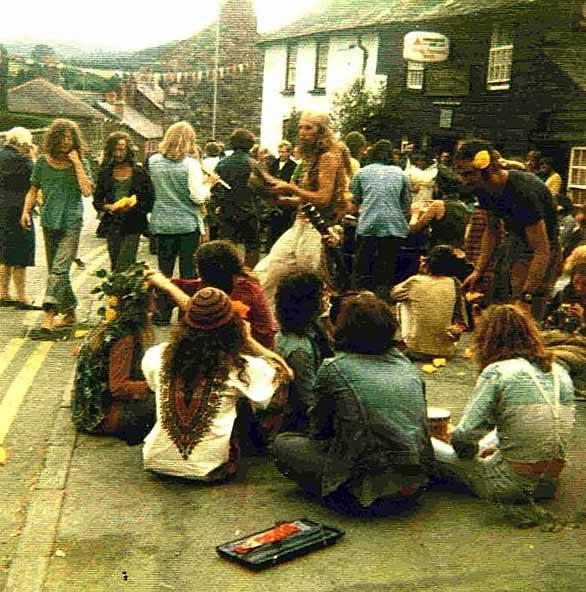
 Police arrive on the scene at Pont Ar Elan in July 1976. Picture by Janet Thompson
 A newspaper clipping reporting on the event. Picture by Janet Thompson


 Tash on YouTube

