
Links
Tag Cloud
- –
- 2023:
- 2024
- Advice
- art
- bill
- bristol
- castlemorton
- CJA
- diy
- exhibition
- festival
- free
- freeparty
- gallery
- green
- killthebill
- law
- liverpool
- march
- nottingham
- ntu
- nuj
- party
- photographer
- Photography
- police
- policing
- portrait
- pro-palestinian
- protest
- protests?
- quote
- rave
- slideshow
- Tash
- tate
- traveller
- travellers
- travellers,
- ukraine
- university
- winchestercourt
- woodthorpe
 Tash on YouTube
Archives
- May 2026
- April 2026
- March 2026
- February 2026
- January 2026
- December 2025
- November 2025
- October 2025
- September 2025
- August 2025
- July 2025
- June 2025
- May 2025
- April 2025
- March 2025
- February 2025
- January 2025
- December 2024
- November 2024
- October 2024
- September 2024
- August 2024
- July 2024
- June 2024
- May 2024
- April 2024
- March 2024
- February 2024
- January 2024
- December 2023
- November 2023
- October 2023
- September 2023
- August 2023
- July 2023
- June 2023
- May 2023
- April 2023
- February 2023
- January 2023
- December 2022
- November 2022
- June 2022
- May 2022
- April 2022
- March 2022
- February 2022
- January 2022
- December 2021
- November 2021
- October 2021
- September 2021
- August 2021
- July 2021
- June 2021
- May 2021
- April 2021
- March 2021
- February 2021
- January 2021
- August 2020
- June 2020
- May 2020
- February 2020
- January 2020
- December 2019
- January 2018
- December 2017
- November 2017
- October 2017
- September 2017
- August 2017
- July 2017
- June 2017
- May 2017
- June 2016
- May 2015
- February 2015
- September 2014
- August 2014
- June 2014
- April 2014
- February 2014
- January 2014
- October 2013
- September 2013
- August 2013
- July 2013
- June 2013
- May 2013
- February 2013
- January 2013
- December 2012
- November 2012
- October 2012
- August 2012
- June 2012
- May 2012
- March 2012
- February 2012
- January 2012
- February 2011
- January 2011
- December 2010
- November 2010
- June 2010
- April 2010
- February 2010
- January 2010
- December 2009
- November 2009
- October 2009
- September 2009
- August 2009
- July 2009
- June 2009
- May 2009
- April 2009
- February 2009
- January 2009
- December 2008
- November 2008
- October 2008
- August 2008
- July 2008
- June 2008
- May 2008
- April 2008
- March 2008
- February 2008
- January 2008
- December 2007
- November 2007
- September 2007
- August 2007
- July 2007
- June 2007
- May 2007
- February 2007
- January 2007
- December 2006
- November 2006
- October 2006
- April 2006
- March 2006
- February 2006
- November 2005
- October 2005
- September 2005
- August 2005
- July 2005
- June 2005
- May 2005
- April 2005
- March 2005
- February 2005
- January 2005
- December 2004
- November 2004
- October 2004
- September 2004
- August 2004
- July 2004
- June 2004
- May 2004
- April 2004
- March 2004
- February 2004
- January 2004
- November 2003
- October 2003
- September 2003
- August 2003
- July 2003
- June 2003
- May 2003
- April 2003
- March 2003
- February 2003
- January 2003
- December 2002
- November 2002
- October 2002
- September 2002
- August 2002
- July 2002
- April 2001
-
Recent Posts
- Observatory : Nottingham Trent University NTU 13 May 2026
- Me in 10mm Wide-Angle 12 May 2026
- Panoramas in BW 10 May 2026
- Saturday Afternoon Panoramas 9 May 2026
- How DiY Sound System blazed a trail for the ’90s free party movement 9 May 2026
- ’90s rave documentary, Free Party: A Folk History, set for streaming release – DJ mag 9 May 2026
- Free Party: A Folk History, streaming event 9 May 2026
- Free Party- A Folk History + Q&A at Bonington Theatre, Gedling, Nottingham 8 May 2026
- A Dope Portrait 7 May 2026
- Berlin Wall Gallery 6 May 2026
- Berlin Eastside Art Gallery 6 May 2026
- Free Party- A Folk History + Q&A at Bonington Theatre 4 May 2026
- A message from NUJ on World Press Freedom Day 2026 3 May 2026
- Today is World Press Freedom Day 3 May 2026
- A Musical Interlude at the MayDay Rally, Speakers Corner, Nottingham 3 May 2026
- Nadia Whittome MP speech disrupted by the RCP at MayDay, Nottingham 3 May 2026
- Chris T, Nottingham NUJ speech on the jeopardy faced by journalists worldwide 3 May 2026
- MayDay Rally at Speakers Corner, Nottingham 3 May 2026
- This World Press Freedom Day, American journalists are under attack 2 May 2026
- Water feature in Sheffield, slow motion 30 April 2026
An ongoing diary of stuff, allsorts, and things wot happen ……
I am a photographer with a special interest to document the lives of travelling people and those attending Festivals, Stonehenge etc, what the press often describe as ‘New Age Travellers’ and many social concerns.
With my photography, I have tried to say something of the wide variety of people engaged in ‘Alternatives’, and youths’ many sub-cultures and to present a more positive view.
I have photographed many free and commercial events and have, in recent years, extended my work to include dance parties (’rave culture’), gay-rights events, environmental direct actions, and protest against the Criminal Justice Act and more recently, issues surrounding the Global Capitalism.
Further, police surveillance has recently become a very important subject for me!
In recognition of this work, received a ‘Winston’ from Privacy International, at the 1998 ‘Big Brother’ Awards. The citation reads: “Alan Lodge is a photographer who has spent more than a decade raising awareness of front-line police surveillance activities, particularly the endemic practice of photographing demonstrators and activists”.
I am based in Nottingham, UK.
Quotes & Thoughts
“Cowardice asks the question, ‘Is it safe?’ Expediency asks the question, ‘Is it politic?’ Vanity asks the question, ‘Is it popular?’ But, conscience asks the question, ‘Is it right?’
And there comes a time when one must take a position that is neither safe, nor politic, nor popular, but one must take it because one’s conscience tells one that it is right.”
Martin Luther King Jr.“In Italy for 30 years under the Borgias they had warfare, terror, murder, and bloodshed, but they produced Michelangelo, Leonardo da Vinci, and the Renaissance.
In Switzerland they had brotherly love – they had 500 years of democracy and peace, and what did that produce? The cuckoo clock!!”
Harry Lime [Orsen Wells] The Third Man 1949“Civilization will not attain to its perfection, until the last stone from the last church, falls on the last priest.”
Emile Zola“….I have an important message to deliver to all the cute people all over the world.
If you’re out there and you’re not cute, maybe you’re beautiful, I just want to tell you somethin’- there’s more of us ugly mother-fuckers than you are, hey-y, so watch out now…”
Frank Zappa
Facebook Pix : Pro-Palestinian Protest and March, Nottingham. 25 May 2024
We humans and other animals live on this planet’s surface ….
We humans and other animals live on this planet’s surface. We are supposed to be here. However, since Enclosure Act 1773, we have fences put up around us with signs saying keep out! Travellers and festival goers have been acutely aware of this when trying to stop and rest on the diminishing common lands. It is all now further extended to much of the population with restrictions on the ‘right to roam’, wild camping, wild swimming and yet more restrictions on the right to protest on such social issues
Less and less hope!

NTU Art & Design Degree Show 2024
NTU Art & Design Degree Show 2024
Display in the Bonington Gallery, NTU
Samsung S22 Ultra – 4K Video 3840 x2160
NTU #ntuartanddesign #nottingham #samsung #S22ultra
Facebook Pix : David Stooke, Artist. Salisbury
After the Beanfield Mission, [16th May], went to visit my mate, Dave Stooke last week. As he remarked, we not seen each other for over 35 years [gosh!]. Many here will know of his paintings.
While there, I wanted to make a set of piccys of the ‘artist in action’. He has started work on pieces for his second book and I wanted to give you some idea of the materials he works with in his studio and his processes. But in such a flying visit, it is obviously impossible for me to convey the fine detail that it takes very many weeks to work on each picture.
Big up Dave 🙂


Revisited the Beanfield : 16 May 2024
Revisited the Beanfield last week. TV company wanted to do an interview about it all, the terrors of the afternoon and the implications for us all since.
Facebook Pix : https://tinyurl.com/2bcwgwd4

Before meeting them, I insisted that they watched our own explanation of events in the film:
Operation Solstice – The Battle of the Beanfield (Director’s Cut extended version)
I have to say it brings up mixed emotions, returning there and looking on the fields 40 years later. Trees and hedges grown, the A303 completely re-routed, a shiny new solar farm in the middle distance. When we finished, I grubbed around the hedgerow and could still find broken glass, bits of rusty metal and rubber. I guess in a couple of hundred years someone might do a thorough ‘archaeological dig’ like at Bosworth Field on Naseby 🙁
To my surprise, I also met the current landowner. The land had been in his family and I think he was about 10yr then and still remembers it all. When introduced, he said, ‘oh were you a policemen?’ … I said ‘no I was one of the others’.
Dropped in to see Dave Stooke while I was in the area …. more of this later. xx
‘Battle of the Beanfield’ Field revisited, July 1985
Our right to roam – victory for Gypsies and Travellers in High Court challenge
Travellers Times 14 May 2024

‘Anti Traveller’ law declared “unjustified discrimination” by High Court judge
The High Court has today ruled that certain parts in the Criminal Justice and Public Order Act 1994 that were introduced in 2022 (the anti-Traveller law), amount to unjustified discrimination against Gypsies and Travellers.
Parliament will now have to review the controversial law to ensure that it complies with human rights.
The High Court challenge was brought by Wendy Smith, a Romani Gypsy. She challenged the anti-Traveller law that gave the police new and extended enforcement powers to evict Romany Gypsies and Travellers from unauthorised encampments, and to seize their homes and send them to prison if they failed to leave.

“The right to roam – our heritage” – Romany Gypsies (Boswell) on South Shore beach, Blackpool, circa 1900 Courtesy of Sharon Heppell
The charity Friends, Families and Travellers supported Wendy Smith with the High Court challenge as interveners.
Abbie Kirkby, Head of Policy and Public Affairs at Friends, Families and Travellers said:
“The new police powers are part of a wider hostile environment against Gypsies and Travellers, particularly for families who have nowhere else to stop.
But, today’s ruling is a triumph for Gypsy and Traveller people, against one of the government’s flagship policies,” added Abbie Kirkby.
“Whilst some of the main provisions in the Act remain, they have been significantly diluted by this ruling.
We extend our congratulations to Wendy Smith and commend her bravery in standing up for what’s right.”

The right to roam – our heritage and history – Irish Traveller children in Anglesey, Wales – Wikimedia commons by Geoff Charles
The new police powers made it a criminal offence, punishable with up to three months imprisonment, for Travellers to pull on to land with their homes, and then fail to comply with a request by the owner of the land to leave. The new powers also forbade anyone forced to leave from re-occupying the land within 12 months.
It was this 12 month no return part of the anti-Traveller law that the High Court said was; “unjustified race discrimination in circumstances where there was a lack of authorised transit site provision on which Gypsies and Travellers could camp lawfully.”
The High Court ruling has thrown the use of all parts of the new police powers into doubt, as police must now act within official police guidance, which campaigners say was an attempt by Police chiefs – who have always said that they didn’t want the new law – to water down the draconian powers contained in the original act of parliament.

A poster protesting about the ‘police bill’, the Act of Parliament that criminalised the nomadic way of life in 2022 (c) Huw Powell
Marc Willers KC, lead counsel for the claimant, commented:
“This is a hugely significant judgment. In granting the declaration of incompatibility, the Court recognised that there is a lack of lawful stopping places for Gypsies and Travellers and that unless the government increases provision, the law as currently drafted will amount to unjustified race discrimination.”
Chris Johnson, the claimant’s solicitor, commented:
“I am delighted for Ms Smith. Key parts of the enforcement powers introduced by the Police Act have been found to be unlawful race discrimination against Gypsies and Travellers. The National Police Chiefs Council never wanted these new powers and following this judgment, it is hard to see what the new powers will add in practice. I hope that Parliament takes this opportunity to look again at the new powers as a whole.”

The right to roam – our present and our future. Appleby 2022 © Bela Varadi
When the anti-Traveller law was first announced by the Government in 2021, it sparked condemnation among Romany Gypsies and Travellers campaigners, who said it would criminalise the nomadic way of life and destroy their heritage.
Drive 2 Survive, a Romani and Traveller-led organisation founded by Sherrie Smith and Jake Bowers, was set up to specifically challenge the new law by holding protests, raising awareness, and building alliances with other minority groups and causes.
On July 7th, 2021 Romany Gypsies, Irish, Welsh, Scottish and New Travellers, Roma, Van-Dwellers and supporters from all over the UK, flocked to Parliament Square in their hundreds to support the Drive 2 Survive rally and show their unity and opposition to the new law, then known as the ‘Police Bill’.

Jake Bowers at the Drive 2 Survive rally, July 2021 (c) Ludovic
Drive 2 Survive’s Jake Bowers said:
“It is fantastic news that the High Court has ruled that the racist anti-Gypsy provisions in the Police Act amount to unjustified discrimination against Gypsies and Travellers.
Coming just days before Romani Resistance day on May 16 which celebrates the only recorded uprising in Auschwitz concentration camp, it just goes to show that when Gypsies and Travellers unite and fight and work directly with powerful lawyers that we are as effective and powerful as any community in Britain.
For those about to go travelling and for those police forces keen on stopping nomadic life, this is a much needed dose of justice.
For the Conservative Party that brought in this piece of ineffective performative cruelty, lets hope it becomes another nail in their electoral coffin. When parliament reviews this legislation it is vital that it changes the law to defend a nomadic right to roam.
Drive 2 Survive was founded to stop this law and it vindicates everything we have done since 2021. We will be congratulating the courageous Romany woman who brought the case and the lawyers and other organisations that supported this crucial fight.”

Drive 2 Survive co-founder Sherrie Smith (left) with Welsh Romani campaigner Alison Hulmes at the Drive 2 Survive 2021 rally (c) Ludovic
The successful claimant, Wendy Smith, was represented by Marc Willers KC and Ollie Persey of Garden Court Chambers. They were instructed by Chris Johnson of Community Law Partnership (‘CLP’). Chris was assisted by Andy Marlow of CLP.
Stephen Simblet KC and Nadia O’Mara acted for the First Intervener, Friends, Families and Travellers (‘FFT’), instructed by Parminder Sanghera of CLP.
This was Chris Johnson’s final case before retirement. For decades, Chris and his team at CLP have been at the forefront of legal challenges protecting and advancing the rights of Gypsies and Travellers. It is fitting that in his final case the Court has issued a declaration of incompatibility, which will have significant wider implications for Gypsies and Travellers.
Well done to all from the Travellers’ Times, and enjoy your retirement Chris Johnson! What a retirement present – and a gift to our communities!

The right to roam – our present and our future. Appleby 2023 (c) Eszter Halasi
TT News
(Lead photo: Romany Gypsy John Doe leads his cart from Stable Way, Hammersmith, to take campaigners to the Drive 2 Survive 2021 rally in Parliament Square (c) Huw Powell)
Download and read the full High Court judgement
Download and read the full Community Law Partnership press release
Facebook Pix : Gaza Protest Camp, University of Nottingham. 36 Edit
Gaza Protest Camp, University of Nottingham. Jubilee Campus 36 Edit
https://tinyurl.com/ywxeuoc9
Have you been there? A documentary photography project on medium format film
Pro-Palestinian Protest, Nottingham 11 May 2024 vid2
Pro-Palestinian Protest, Nottingham 11 May 2024 vid2 Samsung S22 Ultra – 4K Video 3840 x2160
#Gaza #palestine #protest #palestinian #nottingham #samsung #S22ultra
Pro-Palestinian Protest, Nottingham 11 May 2024 vid1
Pro-Palestinian Protest, Nottingham 11 May 2024 vid1 Samsung S22 Ultra – 4K Video 3840 x2160
#Gaza #palestine #protest #palestinian #nottingham #samsung #S22ultra
New Media, New Rules: Reimagining Photojournalism
When was the last time you saw a great news picture? Or a piece of reportage that truly made an impact? Regardless of your opinion of the winners, did you see any of the World Press images winners when they were actually published for the first time? If you can’t recall a specific date, don’t worry; it’s not your fault. The places where one could find valued photojournalism have nearly vanished. Major news publications have either disappeared or are mere shadows of their glorious past. In an era when one could discover great news photography in diverse places such as Wired magazine or Ladies Home Journal, we are now extremely lucky if we find an issue of National Geographic with some amazing images.
An extinction event
Print magazines are dying, and with them, the budgets that sustained a whole community of talented photojournalists. We are losing not only these platforms but also an entire audience of avid news seekers eager to consume well-informed visual journalism. While neither are actually gone, there are fewer and fewer places where they can meet—similar to an extinction event due to a lack of water. Photographers can no longer quench the public’s thirst for news images because there are no more watering holes.
We said this before. It’s time for photojournalism to break free from its symbiotic relationship with news publications, which is proving to be detrimental, much like an abusive marriage. Photojournalism should take cues from the success of video journalism, which has found new platforms to carry its message. Platforms like YouTube, TikTok, and Instagram offer spaces where anyone can discover and share video news without relying on inexperienced, budget-tight gatekeepers. Granted, these platforms can host dubious content, but perhaps that is exactly where photojournalism needs to be, rather than behind a well-guarded, isolating paywall.
Photojournalism still waits for its traditional mentors—the news media—to find a solution. It imposes artificial boundaries on itself, dramatically limiting its reach and effectiveness. Even as platforms like Instagram or WhatsApp have gained immense popularity as sources of image consumption, photojournalists have continually dismissed them as being too lowbrow. Yet, with a savvy strategy, one can achieve far more views and impact with a well-crafted Instagram strategy than by being published in all the magazines in the world. But such strategies need to be built thoughtfully, not as an afterthought.
And that’s the challenge for photojournalism: finding the right format to fit the right medium.
New mediums require new formats and new grammatical rules, which photojournalism needs to learn. It needs to understand which story fits where for which audience. The same way audiences select their content, photojournalists need to select their audience via their media of choice. Yes, even TikTok if it suits the story. Why not? That’s more views than TV Guide at its peak.
So what’s the answer?
Bring photojournalism to the XXI century by sheddings its overbearing grammatical and structural chains:
Escaping the traditional photo essay/reportage format that benefited its magazine era but is now suffocating it. There are no more double-page spreads; in fact, there are hardly any horizontal formats left. The opening image, the close-up—all these refer to layouts that have long died. Even the concept of a photo essay is becoming obsolete. If you’re lucky, you might get a slideshow on a news website, but it does not care about your carefully crafted visual narrative. Each image boringly pushes the other away, and the format really dislikes verticals. Think in powerful unique images. Tell a story in one image.
Reduce the over-reliance on captions. Captions should complement well-crafted images, not serve as their explanation. News images ought to be easily understood without text, particularly when published in a relevant context. Depending too much on captions can lead to uninspiring visuals. By minimizing this reliance, photojournalism can seamlessly integrate into fast-paced media platforms like Instagram, Snapchat, and Pinterest, where quick visual comprehension is crucial. Embrace the use of idioms, symbols, and signs to convey meaning visually.
One major barrier for photojournalism to break free from its restrictive ties with traditional news media is the issue of credibility. Previously, a news image had to be published by a well-respected publication to be considered credible. This is no longer the case.
With the adoption of frameworks like Content Credentials or Liccium, photojournalism can now self-certify, eliminating the need for third-party authenticity checks. As support from traditional news media dwindles, it’s essential to transition to a platform-agnostic approach. News images should stand as self-validating units of truth, accessible and shareable across any platform, at any time. The primary focus must shift to maximizing impact and raising awareness.
Finally, we can mimic the advertising world. For decades now, it has relied on AI to analyze and understand what images work where for whom. Why not use the same data to create more impactful content targeting a specific audience? After all, aren’t photojournalists also selling ( in this case, a story)? This data-powered visual approach can also serve in determining ahead of the shoot which platform would have the most impact as well as recommending format, dominant colors and publishing platforms for maximum impact and reach in for a targeted demographic. Thus, instead of relying on who will buy your reportage, become proactively active in reaching directly to the core target for maximum reach and impact. Go after the audience instead of waiting for it to come to you. Yes, ethical clickbait photojournalism.
And the money in all that?
As we have all witnessed, in this world, audience equals money. If you can raise an audience, you can convert it into income. Magazines have lived off this premise for decades, why not photojournalists ?
The landscape of media is not just changing; it has already changed. Traditional news media, once the lifeblood of photojournalism, have become its chains. If photojournalists continue to cling to outdated formats and channels, they risk irrelevance in a world where content is king and distribution is queen. We must seize the tools of our era—data analytics, mobile platforms, social media—and wield them not just competently, but with groundbreaking creativity. Photojournalists must become their own publishers, their own advocates, and, most importantly, their own validators. The time for waiting is over. The time to act is now, using every tool at our disposal to ensure that the stories that matter don’t just survive, but thrive. Let us not be content with mere adaptation. Instead, let us redefine the very essence of what it means to communicate visually in the digital age.
Facebook Pix : Pro-Palestinian Protest, Nottingham. 11 May 2024 72edit
Facebook Pix : Pro-Palestinian Protest, Nottingham. 11May 2024 72edit
Peregrine : First chick … 3 more to go xx
Peregrine Falcon, a first chick … 3 more to go. High up on the Newton Building, Nottingham Trent University
Di Peasey NUJ Speech on killing of Journalists in Gaza by Israeli Forces and elsewhere, MayDay 2024
Di Peasey NUJ Speech on killing of Journalists in Gaza by Israeli Forces and elsewhere, Nottingham Mayday Rally, 4th May 2024 Insta360 Ace Pro – 4K Video 3840 x2160 #cuts #nottingham #NUJ #unions #protest #insta360 #acepro #4k
Attacks on press freedom around the world are intensifying, index reveals
In the past year, in virtually every region, journalists and independent media outlets faced increasing repression
Annie Kelly Fri 3 May 2024 05.00 BST
Political attacks on press freedom, including the detention of journalists, suppression of independent media outlets and widespread dissemination of misinformation, have significantly intensified in the past year, according to the annual World Press Freedom Index published by Reporters Without Borders (RSF).
The index ranks 180 countries on the ability of journalists to work and report freely and independently.
In a year when more than half the world’s population will go to the polls in democratic elections, the RSF’s index shows an overall decline in press freedom globally and a steep rise in the political repression of journalists and independent media outlets.
“RSF sees a worrying decline in support and respect for media autonomy and an increase in pressure from the state or other political actors,” said Anne Bocandé, RSF editorial director. “States and other political forces are playing a decreasing role in protecting press freedom. This disempowerment sometimes goes hand in hand with more hostile actions that undermine the role of journalists, or even instrumentalise the media through campaigns of harassment or disinformation.”
The Maghreb and Middle East regions performed the worst in terms of restrictions on press freedom by government forces, according to the report. In the past year, said RSF, governments across the region have attempted to control and curtail the media through violence, arrests and draconian laws, compounded by “systematic impunity for crimes of violence against journalists”.
The RSF says that, since October 2023, more than 100 Palestinian reporters have been killed by in Gaza, including at least 22 in the course of their work.

Elsewhere in the region, journalists have been killed in Sudan, where there have been serious attempts to curb independent reporting of violence and civil war. The situation for media professionals in Syria has also deteriorated, with journalists who have fled press repression in their home country threatened with expulsion from neighbouring Jordan, Turkey and Lebanon. The RSF also says that four of the world’s biggest jailers of journalists – Israel, Saudi Arabia, Syria and Iran – have continued to attack and detain them.
The RSF says that Latin America is also showing alarming indicators of political repression of journalism. In Argentina, the new president, Javier Milei, has boasted about his assault on the free press and has shut down the country’s biggest new agency. Press freedom is also under sustained political attack in Peru and El Salvador.
The US has performed badly due to increasing attacks on journalists from political officials, including public calls to imprison reporters.
Elections in sub-Saharan Africa saw violence against journalists fuelled by political attacks on media freedom. In Nigeria nearly 20 reporters were attacked in early 2023, and in Madagascar, reporters were targeted while covering pre-election protests. More recently, Burkino Faso has suspended dozens of foreign news organisations, including the Guardian, over reporting of an alleged massacre of hundreds of civilians by the Burkinabe army.
In Europe, the index showed Russia dropping down the ranks of countries mounting attacks on press freedom for what the RSF terms its “crusade” against independent journalism. More than 1,500 Russian journalists have fled abroad since the invasion of Ukraine in 2022.

Belarus’s position near the bottom of the RSF’s index is due to the persistent persecution of journalists under the pretext of combating “extremism”.
Last week, a report by the German-based Civil Liberties Union for Europe (Liberties) warned that press freedom is “perilously close to breaking point” in several European countries.

Repression of the free press also worsened in the Asia-Pacific region. The RSF says that the region’s dictatorial governments have been tightening their hold over news and information with “increasing vigour” in countries such as Afghanistan, where the Taliban have all but destroyed independent journalism, and North Korea and China’s “all-out persecution” of local media. Vietnam and Myanmar also fell in the rankings this year due to their pursuit of mass imprisonment of media professionals.
The RSF also painted a bleak picture of the increasing use of artificial intelligence, calling its use in the arsenal of disinformation for political purposes “disturbing”, with deepfakes being used to influence the course of elections.
Reporting on the war against nature is also proving increasingly dangerous. Forty-four journalists have been killed for covering environment stories over the past 15 years, according to a separate report by Unesco, which organises today’s World Press Freedom Day.
Mayday Parade in Nottingham : Unions : Cuts : Gaza
Dance in protest: 30 years of the UK’s anti-rave Criminal Justice Bill
DJmag HAROLD HEATH 1 May 2024, 14:30
1st May 1994 was the first big London protest against the looming Criminal Justice Bill, the piece of legislation that first proscribed a genre of music — rave music, “wholly or predominantly categorised by the emission of a succession of repetitive beats” — in law. Despite widespread demonstrations at what was seen as draconian power-grabs by the UK authorities, the Bill became law later in 1994. Here, Harold Heath looks back at the reaction from the dance music community at the time, and the Act’s lasting impact on the rave scene today
The Criminal Justice and Public Order Act was passed into UK law in November 1994. Infamous for targeting events that played music “wholly or predominantly characterised by the emission of a succession of repetitive beats”, the act gave the police sweeping new powers to “remove persons attending or preparing for a rave” — yes, they actually legislated specifically against raves.
A rave was defined as any gathering of ten people or more; police could order such gatherings to disperse, and could turn back anyone within a mile radius, with three-month prison sentences or £2,500 fines for non-compliance. The bill also targeted, amongst other things, squatters, eco-protesters, hunt saboteurs and so-called ‘new age’ travellers, as though the ruling Conservative Party had launched an attack on every single subculture that they felt somehow threatened traditional British decency and law and order.
The Criminal Justice Bill (soon abbreviated to ‘CJB’ – it was a ‘bill’ before it was passed, an ‘act’ after) was an ill-thought-out, rushed and vindictive reaction to — chiefly — the legendary Castlemorton festival in spring ’92. For a week, between 20 and 30 thousand people (estimates vary) took part in one of the single most beautiful expressions of dance music’s power to create community — or took part in the end of civilisation as we know it via the ‘Evil acid house cult’ (TM The Sun newspaper), depending on your point of view.
At the time, the co-founder of DiY Sound System, Grace Sands, was one half of DJ duo Digs (Grace) and Woosh (Pete Birch RIP). “The CJB was the response to the Castlemorton Festival,” she recalls. “DiY Sound System were there, playing house, funk and disco, alongside Spiral Tribe, Circus Warp, Circus Normal and other sound systems playing tougher ravey sounds and techno. It was a huge, fun, illegal gathering with waves of people coming over the weekend to shake a booty and get wild. The powers that be weren’t impressed at all! It was bittersweet that such a great week could have such a negative reaction.”

Credit: Matt Smith
“It was a knee-jerk reaction from an establishment shit-scared that ‘we’ — a mixed bunch of townies, crusties, clubbers, ravers, gays and straights — could organise ourselves that well.” – Grace Sands, Digs & Woosh
Simone ‘Sim Simmer’ Feeney, Spiral Tribe co-founder and the Tribe’s MC, felt the full weight of the state’s attention following Castlemorton. “We were just a bunch of ravers that wanted their music to go on a bit longer than we were allowed to,” she remembers, “but just from that small action we felt the wrath of politics breathing down our necks, and the reactions at the time were just crazy.”
Those reactions included police becoming more heavy-handed, like when they violently broke up one of Spiral Tribe’s parties in ’92 using a JCB industrial digger to smash through a wall. Tribe DJ and producer Ixindamix was there that night too. “We got beaten up by riot police at a party in Acton Lane in April 1992,” she tells DJ Mag. “It was most certainly police and government intervention — starting at Acton and culminating with having the sound system, trucks and all our possessions confiscated after being arrested leaving Castlemorton — that influenced our decision to leave Britain in order to go party elsewhere.”
The Criminal Justice Bill (CJB) was the latest in a series of government attempts to end illegal raves, following the failure of the Entertainments (Increased Penalties) Act in July 1990 to have much effect at all, as demonstrated by the flourishing illegal rave scene in ’91/‘92. “The movement had grown across the summer from ’91 to ’92 when all the raves moved outside,” Simone says, “and we’d joined up with the travellers and reignited the flame of the free festivals. And then obviously Castlemorton was massive and put the fear of God into the authorities, which is why they took us to court — it was all a political stitch-up.” Following one of the most expensive trials in UK history, in 1994, all 13 Spiral Tribe members who’d been arrested after Castlemorton were found innocent. “And it was shortly after that,” Simone recalls, “that they introduced the Criminal Justice Bill.”
It’s difficult not to view the sections of the act that dealt with raves as a demonstration of how fearful the government were at the sight of thousands of young, often working class people organising themselves through self-made, covert networks and gathering together, often on the land of the Conservative gentry. Grace attempts to sum it up: “It was a knee-jerk reaction from an establishment shit-scared that ‘we’ — a mixed bunch of townies, crusties, clubbers, ravers, gays and straights — could organise ourselves that well.”

Credit: Matt Smith
Widely criticised by human rights organisations, the CJB was a piece of legislation that was, in the words of DiY Sound System’s Harry Harrison in his book Dreaming Of Yellow, “…so egregious in its provision that an entire subculture rose up to prevent it becoming law”. Following its announcement at the Tory party conference of October ’93, dancers, DJs, MCs, promoters, musicians and producers united with squatters, eco-protesters, travellers and ‘crusties’ to organise a network of protest and agitation, all based around the UK’s travelling sound systems. Fundraisers were held, protests were organised, literature, posters and placards were produced, and coaches to London protests and support for those arrested at the protests was provided. The fight was on.
Musician, composer and producer Lol Hammond (Spiral Tribe, The Drum Club), along with Dave Watts of Fun-Da-Mental, Charlie Hall from Drum Club, Miquette Giraudy and Steve Hillage, recorded the ‘Repetitive Beats’ EP in protest at the CJB in ‘94. Lol recalls Mr. C from The Shamen paid for the video out of his own pocket, from royalties from The Shamen’s No.1 smash ‘Ebeneezer Goode’. “The CJB was a total kick in the teeth for our rights,” Lol tells us. “That stupid ‘ten people dancing to repetitive beats’ rule… It really politicised people. Our culture has always been seen as very hedonistic, just getting on one and dancing, which is fair enough, but this really galvanised a lot of people — our whole lifestyle was under threat.”
Lol appeared on the front cover of music paper Melody Maker in October ‘94 along with other vocal anti-bill campaigners Andrew Weatherall, Dave Watts, Kris Needs and Bobby Gillespie from Primal Scream above the tagline ‘Beat Fighting Men line up against the CJB’. Released on Nina Walsh’s Sabrettes label, ‘Repetitive Beats’ peaked at No.80 in the national charts.
As a former squatter, long-time supporter of human rights organisation Amnesty, and a rave musician, Orbital’s Phil Hartnoll was extremely vocal about the bill at the time. “It was just another attack on dance music and raves,” he says. “And the fuss they made about ecstasy, when how many alcohol-related deaths were there that year?” Phil spoke at a couple of anti-CJB demos, and Orbital released a completely silent ‘Criminal Justice Bill?’ protest mix of their ‘Are We Here’ track which reached No.33 in the UK national chart in September ‘94.
Still reassuringly angry after all these years, Phil, like so many in dance music, was incredulous at the ridiculousness of the legislation: “It was all done under the banner of repetitive beats — so they’re trying to explain what a fucking rave is. ‘Oh, it’s repetitive beat music’, but I’m like, ‘Wait a minute, an orchestra can’t play in fucking time with each other if there isn’t a repetitive beat!’ So that was a load of bollocks!”

Credit: Matt Smith
“It brought everybody from every background together, hugging on the dancefloor: barristers, window cleaners, teachers, nurses, football hooligans, all together, not giving a shit about what your background was or what your views were…” – DJ Graeme Park
DiY and Leeds band Chumbawamba collaborated on their ‘Criminal Injustice’ protest track, while electronicists Autechre put out the ‘Anti’ EP on Warp, a tune programmed to have non-repetitive beats, with profits going to human rights organisation Liberty. Dreadzone’s ‘Fight The Power’ was also released in ’94 to support Liberty in the fight against the bill, and was included on the ‘Taking Liberties’ compilation, which also featured music from Orbital, Galliano, Transglobal Underground, Test Dept, Loop Guru, The Orb, Ultramarine, Zion Train, Aphex Twin under his Caustic Window moniker, and The Shamen. And although Liam Howlett later denied it, it’s hard not to read The Prodigy’s ’94 album ‘Music For The Jilted Generation’ — with its inside sleeve art depicting a raver giving the finger to the police while heading off to a rave, and its ‘How can the government stop young people having a good time fight this bollocks’ sleeve-notes — as a very clear reaction to the bill.
DJ Graeme Park remembers the CJB well: “Ecstasy and acid house meant that you just could not stop people wanting to carry on enjoying themselves communally,” he tells DJ Mag. “It brought everybody from every background together, hugging on the dancefloor: barristers, window cleaners, teachers, nurses, football hooligans, all together, not giving a shit about what your background was or what your views were… With this stupid, ridiculous, reactionary, nonsense bill they were trying to stop a cultural revolution.”
Park recalls receiving a call from dance music aficionado Neil Rushton in early ‘94: “Neil was immediately on the phone, sharp as a knife, and he said ‘I want to do a quick compilation, ‘No Repetitive Beats’.’ I was like, ‘What a brilliant idea’.” Graeme mixed the ‘No Repetitive Beats’ compilation on Six6 Records, which included tunes from Inner City, Glam, Cool Jack and Terrence Parker. Royalties went to DiY’s All Systems No, a grass-roots response to the CJB from DiY and other UK systems.
Word about the CJB’s proposed wide-ranging powers spread rapidly through the counter-cultural underground. “We had an initial meeting with various sound systems from the East Midlands/Yorkshire area including DiY, Smokescreen, SPOOF, Pulse, Rogue, Babble and Breeze,” DiY’s Harry tells us. “We couldn’t believe what we were reading, that our way of life was being criminalised. All Systems No’s mission was to raise as much money as possible to fight the CJB, which resulted in us subsidising several coaches to the demos, printing tens of thousands of flyers and booklets to inform people, and the purchase of a ‘kamikaze’ rig which could be seized by the police without risking our own systems.”

Credit: Matt Smith
Two of the main organisations involved in the three large CJB London protests in 1994 were The Advance Party and The Freedom Network, a broad coalition of sound systems and party-goers, squatters, travellers, civil liberties groups, road protesters, hunt saboteurs and free party organisers. Photographer Matt Smith went with his Sunnyside sound system to the first two marches, and along with other sounds put on a free party on Wanstead Common after the protest. Matt and some friends had moved to Bristol from London in ’93, “with the express intention of opposing the legislation in as many ways as possible,” he says, “simply because we thought it was not right — and Sunnyside came together through that… We threw parties to raise money and raise awareness, using rave as a networking tool to entertain, amuse and inform and to create information dissemination. We ended up taking Bristol to London on a few occasions.”
The first big protest against the CJB, a march from Hyde Park to Trafalgar Square in central London organised by the Advance Party, took place on Saturday May 1st 1994 — May Day. This was soon followed by a second big mobilisation on July 24th, about twice the size of the first. The first two major protests were largely peaceful. “It was massively celebratory,” says Matt of the first one, “and we were full of naive zeal that we were going to change the fucking world.”
Matt, like many in dance music, had begun to think that just maybe change was possible, that perhaps this huge collective opposition might actually make a difference. Sunnyside parked their rig outside the National Portrait Gallery in central London. “A 10k rig on the back of a seven-and-a-half-tonne truck,” he remembers with a mix of delight and pride, “and that fucking moment when we turned the music on, the whole of Trafalgar Square turned round and roared at us like a football crowd — that was life changing.”
The third London protest took place on 9th October and, following the rally in Hyde Park, violence broke out after the police turned on the protesters with tear gas and horse charges. As the date for the bill to become law approached, there was a growing sense that the end was drawing near. Lol mentions reaching out to well-known and mainstream figures in dance music at the time. “Honestly, I gave it everything, we really fucking went for it, and I’m sure we did raise awareness a bit — but not enough,” he says. “DJ Mag, Mixmag, The Guardian and Melody Maker supported us but it would have been brilliant if we could have got more of the mainstream involved.”
Matt remembers Labour MPs Tony Benn and Jeremy Corbyn speaking at the first march, but ultimately Labour Shadow Home Secretary Tony Blair decided not to oppose the bill on its final reading, perhaps not wishing to damage Labour’s prospects in the next election by appearing soft on crime, and the CJA became law in November 1994.

Credit: Matt Smith
“The BBC angle was ‘Everything finished with Castlemorton’, and I’m like ‘Bollocks did it!’ Ten years later there were probably more on Steart Beach than there were at Castlemorton.” – Matt Smith
The accepted narrative is that the act killed illegal raves, moving the scene into licensed venues where profits could be taxed, and closing times, noise levels and quantities of people controlled — and that this fostered the rise of superclubs like Cream and Ministry. As writer Ed Gillett in his excellent Party Lines book states, post-CJA, “UK dance music’s focus shifted to the booming market of superclubs and festivals — dancing not as a form of anti-social defiance, but a fully regulated leisure activity.”
Certainly the act had an immediate effect on the free party scene: in June ’95 a last-ditch attempt at a large-scale Castlemorton-style free party, the ‘Mother’ festival, was forcibly shut down by the police. But Gillett also notes that illegal events weren’t ending, they were “retreating into the shadows”, an important point echoed by several of our contributors. “The police had effectively militarised the South-West in England after Castlemorton,” Harry from DiY says, “so from the summer of ‘93 onwards there was no chance of another big free festival… but from being a huge social movement, the free festival/party scene simply went back underground.”
This is a key point in the CJA’s legacy, perfectly illustrated by how Matt spent the decade that followed. “I spent ten years running free parties throughout the ‘90s and early 2000s all over the country, and never got busted once!” he shares gleefully. “The last thing I ever really got involved with was the 10th anniversary of Castlemorton on Steart Beach in Bridgewater.” The Steart Beach rave, where a huge amount of sound systems — anecdotally, Matt heard it was forty-eight — played host to 16,000 people partying for a week. “The BBC angle was ‘Everything finished with Castlemorton’, and I’m like ‘Bollocks did it!’ Ten years later there were probably more on Steart Beach than there were at Castlemorton.”
Ironically, the protests against the CJB brought many disparate people together in a great cultural networking exercise that ultimately undermined many of the act’s anti-rave aims. “The repression by the state,” says Harry, “had the opposite effect to that intended in that it brought the systems together in a solidarity which endured.” Rather than completely ending illegal raves, the legislation simply meant that party organsiers brave enough to take the risk had to find new locations — often returning to cities and squat-parties — and new strategies to outfox the authorities. “I think the act might have temporarily pushed everyone deeper underground, but it didn’t kill the spirit at all,” Simone tells DJ Mag. “It made the whole movement gain momentum and become stronger… it pushed it deeper underground and the roots spread. You might stop the party, but you can’t stop the future.”

Credit: Alan Lodge
For many of the UK’s intrepid party creators, the party just relocated, as sound systems like Spiral Tribe, Desert Storm and Total Resistance moved to Europe and kick- started the Teknival movement. Others stayed in the UK, developing a strand of clubbing — including Lol’s Drum Club night, Megadog, Return To The Source, Tribal Energy, Megatripolis and Whirl-Y-Gig, amongst many others — which was dedicated to keeping the free festival ethos alive within licensed club nights.
It’s well worth mentioning that the post-CJA rise in legal dance music club culture wasn’t inherently bad, of course; clubbing may have been more expensive and less wild than illegal raves, but there’s no doubt that the club nights that blossomed in the second half of the ‘90s — Metalheadz, Speed, Bugged Out!, Heavenly Social, Manumission, Stealth, Gatecrasher to name just a few — were absolutely world beating; and those that had started before the act, such as Cream, Trade, Slam and Back To Basics, all thrived in the second half of the decade too. As Matt notes: “The criminalisation of the big parties led to more developments in the legal club world… free parties are more of a lifestyle commitment, but by the 2000s everybody was raving and you had the Gatecrasher kids and all those incredible style tribes that came out of that late ‘90s superclub evolution.”
An unexpected effect of the act and the protests was their influence on what became the UK’s festival industry. Matt recalls doing a nationwide tour with a bunch of free party people at the time, many of whom now, like Chris Tofu MBE from Continental Drifts who currently oversees the Shangri-La area at Glastonbury, run the UK festival world. The illegal raves that were created from the unholy alliance between the travellers’ free festivals and the ravers’ parties contained the creative and practical DNA for our current summer-long festival season. As Harry says: “What had been dangerous and radical was sanitised, commodified and sold back to the people.”
Ultimately, if the CJA aimed to kill illegal raves, it failed. It certainly curtailed them, made the stakes higher for the organisers, and literally drove some UK sound systems out of the country. But as Spiral Tribe’s Ixindamix tells DJ Mag: “People will always party and celebrate, dancing to beats is an age-old human instinct. No matter what laws are created, people will always find a way to party together — it’s inevitable.
“Similar acts have been brought in around Europe,” she continues, “we’ve seen horrendous police violence directed at ravers in France, and at the moment there are particularly harsh laws in Italy promising long jail sentences for organisers — but the scene is so popular that people will always find ways around the rules, whether it’s finding cunning ways to elude the police, building ‘suicide rigs’ or simply having smaller events in remote places. The movement will continue.”
Kent State Shooting. 4th May 1970

54 years ago …. This is all happening again ….
John Filo’s haunting photo from the Kent State massacre on May 4, 1970, has never been more relevant.
Angry student protestors confronted Filo, demanding to know why he was taking pictures, screaming, “What kind of a pig are you?”
Filo responded, “No one’s going to believe this happened,” then pointed to his camera. “This is proof.”
This is happening again
Then it was Cambodia / Vietnam …. now Israel / Gaza …Same shit
Kinder Trespassers ‘would today be kettled and labelled extremists’
Bob Smith, Editor
Monday 25 April 2016 01:57 PM GMT
If the Kinder Scout Mass Trespass took place in 2016, its participants would likely have been kettled before getting out of the car park and labelled extremists, an outdoors expert said.
Carey Davies, hillwalking development officer with the British Mountaineering Council, made the point at a meeting to commemorate the 1932 event in the Peak District.
He was speaking at the fourth annual Spirit of Kinder day in Hayfield, the village from which the walkers set out for their attempt to reach the area’s highest hill.
Mr Davies said the longing for a vision of the land ‘for a sense of space and a sense of place’, was universal, describing a recent walk he took through war-torn Palestine.
He said: “With the benefit of hindsight, the Kinder Trespass has now become heritage; an act which mainstream politicians and respectable organisations now feel comfortable endorsing.
“But let’s take a closer look at it. There were 400 young people, many of them unemployed, led by people from ethnic and religious minorities, all following a radical ideology. We shouldn’t lose sight of just how challenging and provocative it was.”
He pointed out there were still barriers of access, social background, ethnicity, gender, mental illness or disability which prevented many people in this country from knowing the lasting satisfaction of a long walk or a hard climb.
He said the BMC was working in partnership with other organisations to try and do what it could to help people overcome these barriers, and crowdfunding campaigns like the BMC’s Mend Our Mountains were repairing badly-eroded paths, such as that below Ringing Roger on Kinder.
“Too many people live lives without landscape, in nondescript and forgotten places which foster a sense of marginalisation and contempt,” Mr Carey said. “Access to the outdoors has to be seen as part of a social whole. I believe the Kinder Trespassers understood this well. Their struggle was always part of a struggle for something bigger.”
The event marked the confrontation between the trespassers, led by Benny Rothman, and the Duke of Devonshire’s staff on the hillside, and was organised jointly by the Kinder Visitor Centre Group and the Kinder & High Peak Advisory Committee. A highlight was readings by pupils from New Mills College and Hayfield Primary School, describing their feelings of freedom after a walk on Kinder.
Dave Toft of the KVCG outlined the story and background to the trespass, and claimed Kinder Scout and access to its moors was the children’s’ birthright. “But according to figures from Natural England, only 8.7 per cent of the country still has free access. So as Benny Rothman would say, our work is not complete.”
Philip Pearson, former senior policy officer at the Trades Union Congress, and a keen hillwalker, spoke about Benny Rothman’s work as a trade union organiser, in addition to his being the leader of the Kinder trespass.
He said that the environment and climate change were major issues for trade unions today, which he felt Benny would have well understood, and he outlined was unions were doing about it. He added that a local pupil had written: “Freedom means everything to me – it allows me to be the person I am.” Mr Pearson said: “This said everything about Benny Rothman, the leader of the trespass.”
Mark Metcalf, author of a new biography of Rothman, explained that Rothman’s four months imprisonment was not wasted, because while he was there he learnt shorthand, which stood him in good stead in his future life as a union negotiator.
Musical interludes were provided by folk singer Brian Peters, who led the traditional final singing of Ewan MacColl’s Manchester Rambler.
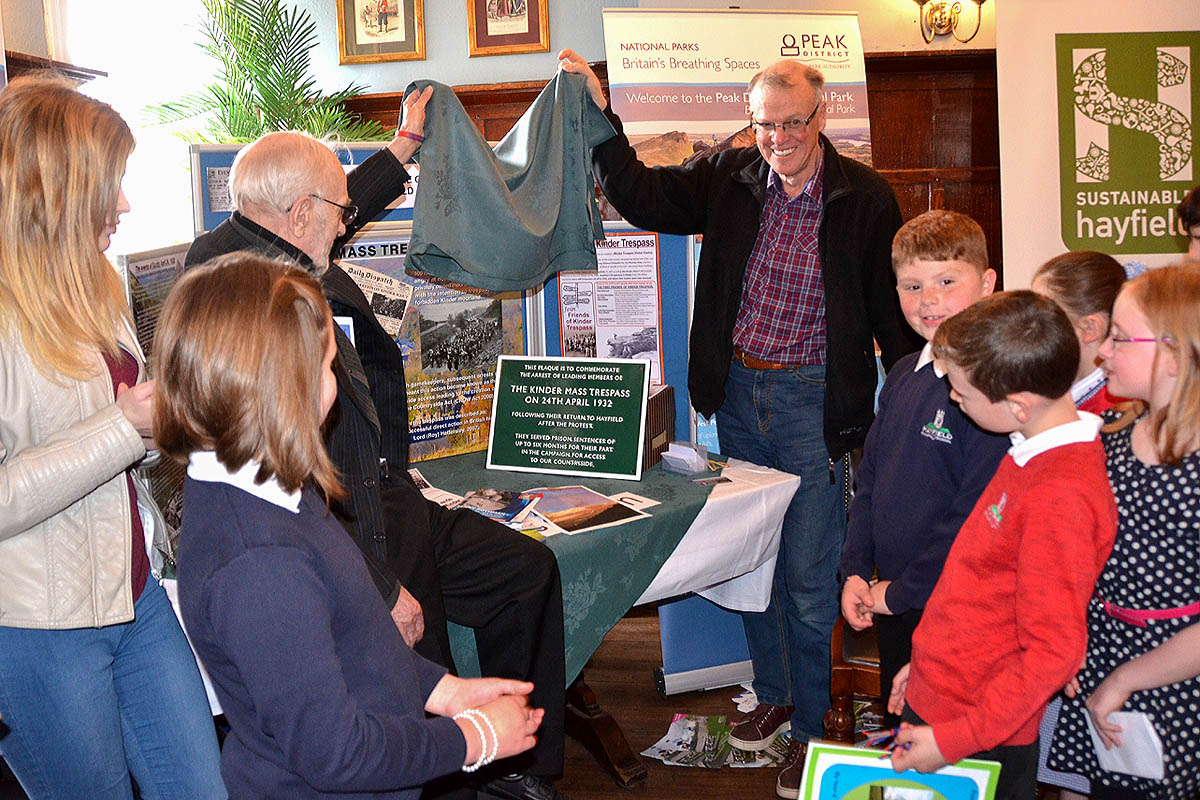
Jan Gillett, son of one of the imprisoned trespassers and 86-year-old Alan Edwards of Stockport, who as a two-year-old had been carried there by his elder sister, unveiled a commemorative plaque which will eventually form part of a Trespass Trail.
Exhibitions of work by local children and local artist Sarah Morley were held in the Village Hall. On Sunday walks were led on the trespass route.
Among the organisations attending the event were the Ramblers; Sheffield Campaign for Access to Moorland; British Mountaineering Council; the National Trust; Hayfield Civic Trust; Sustainable Hayfield; the Kinder Mountain Rescue team and Friends of the Peak District.