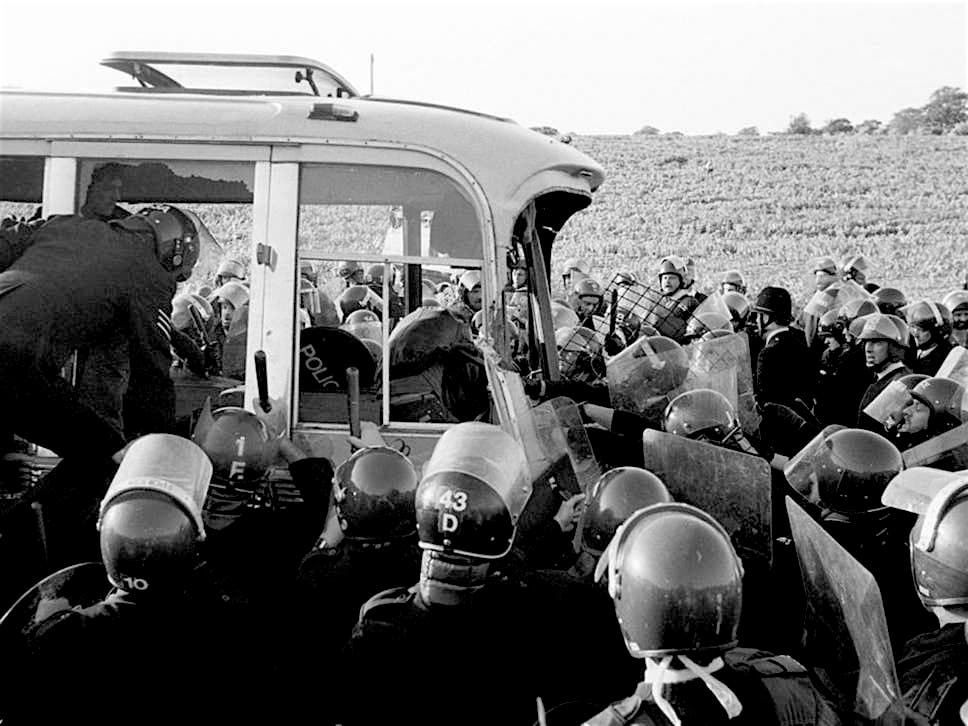
Police swarm the last bus at the Battle of the Beanfield.
38 years ago, on June 1, 1985, a convoy of vehicles carrying what the photographer Alan Lodge described as “a small, mild mannered bunch of people” — around 550 men, women and children, generally described at the time as New Age Travellers — was ambushed and “decommissioned” with extraordinary violence by around 1,4000 police from six countries and the Ministry of Defence, in what has become known as the Battle the Beanfield — although, as I stated in my article marking this horrendous event last year, “‘battle’ suggests the presence of two more or less equal parties engaged in conflict, when what actually took place was a one-sided rout of heartbreaking brutality.”
The convoy was hoping to reach Stonehenge, to establish what would have been the 12th annual free festival in fields opposite the ancient temple on Salisbury Plain, which had grown, by 1984, into an anarchic settlement that welcomed tens of thousands of visitors throughout the whole of June. An injunction had been served, intended to prevent anyone from reaching Stonehenge, and from the summer before travellers, environmental protestors and festival-goers had been harassed and assaulted from Yorkshire to RAF Molesworth in Cambridgeshire, where a peace camp, echoing the famous Greenham Common Women’s Peace Camp, had been established to resist the planned introduction of a second US cruise missile base on UK soil until it was evicted in February 1985 in the largest peace-time action involving British troops, led by the then-foreign secretary Michael Heseltine.
Undeterred, however, the convoy had set off for Stonehenge from Savernake Forest in Wiltshire on June 1, but soon met with trouble. After the police blocked the road seven miles from Stonehenge, and officers began smashing the windows of stationary vehicles and the occupants were ”dragged out screaming”, as Tony Thompson explained in an article for the Observer in 2005, the majority of the convoy sought to avoid the violence by driving into a nearby beanfield.
There was a tense stand-off until 7pm, when, as Thompson described it, “all the officers had changed into riot gear”, and the “final assault” began. As Thompson put it, “Pregnant women were clubbed with truncheons, as were those holding babies. The journalist Nick Davies, then working for the Observer, saw the violence. ‘They were like flies around rotten meat,’ he wrote, ‘and there was no question of trying to make a lawful arrest. They crawled all over, truncheons flailing, hitting anybody they could reach. It was extremely violent and very sickening.’”
As Thompson proceeded to explain, “When some of those remaining tried to get away, driving their vehicles through the beanfield, the police threw anything they could lay their hands on — fire extinguishers, stones, shields and truncheons — at them in order to bring them to a halt. The empty vehicles were then systematically smashed to pieces and several were set on fire. Seven healthy dogs belonging to the Travellers were put down by officers from the RSPCA. In total, 537 people were arrested — the most arrests to take place on any single day since the Second World War.”
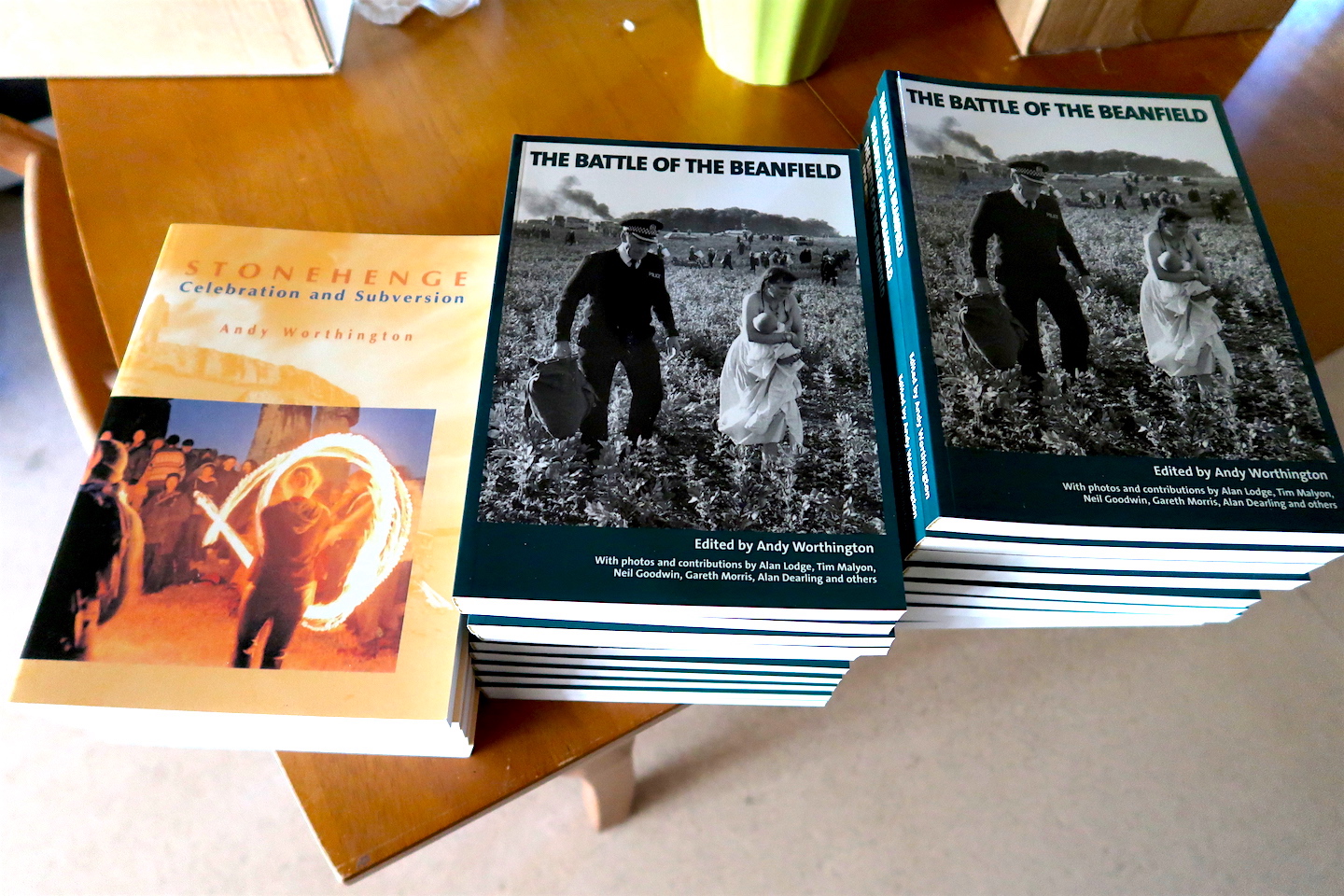
Thompson’s article coincided with the publication of my book The Battle of the Beanfield, which is still in print, and, as I explained to him at the time, “The Battle of the Beanfield remains a black day for British justice and civil liberties. From the anti-Traveller legislation of the 1986 Public Order Act and the 1994 Criminal Justice Act to the current hysteria surrounding Gypsy and traveller settlements, the repercussions are still being felt.”
Although those arrested on the day were subsequently “charged with obstruction of the police and the highway”, in Thompson’s words, “most of the charges were dismissed in the courts”, in large part because of evidence of police brutality submitted by the Earl of Cardigan, “whose family owned the forest where the convoy had stayed the night before.” The Earl had tagged along with the convoy out of curiosity, and his intervention “prevented what might otherwise have become a major miscarriage of justice.”
The Public Order Act 1986
Nevertheless, despite losing in court (in 1991), the government had already put in place legislation that would ensure that they could continue to abuse the already abused — but this time on a firm legal footing. The 1986 Act was the first major update to the Public Order Act since it was first introduced in 1936, when it was aimed particularly at controlling the rise of fascist groups.
While the new Act addressed some glaring loopholes in the law, combatting efforts to stir up racial hatred, for example, its response to the Beanfield — and to the wider context of the time, especially involving the Miners’ Strike — was, as the legal scholar David Dixon explained in 1987, “re-presented in the distinctive guise of authoritarian populist policies … ensuring that the clear priority would be ‘law and order’, rather than the definition and protection of rights to protest and demonstrate.”
After years in which, as I explained two years ago, “the assertion of a claimed right to gather freely in significant numbers without prior permission … had often been tolerated by the authorities”, the aftermath of the Beanfield “marked a noticeably authoritarian shift in the politics of dissent.”
In dealing with “public assemblies”, the Act gave the police the power to restrict “an assembly of 20 or more persons in a public place which is wholly or partly open to the air”, if they “reasonably believe[d]” that it “may result in serious public disorder, serious damage to property or serious disruption to the life of the community.”
The Act also imposed a requirement for six days’ written notice to be provided to the police before most public processions, and empowered the police to impose conditions on processions “to prevent serious public disorder, serious criminal damage or serious disruption to the life of the community.”
The Act also took aim at Gypsies and Travellers (and at free festivals), via Section 39, which stated that, if the police “reasonably believe[d] that two or more persons have entered land as trespassers and are present there with the common purpose of residing there for any period”, that “reasonable steps have been taken by or on behalf of the occupier to ask them to leave”, and that either damage or threats have been undertaken by the trespassers, or that they “have between them brought twelve or more vehicles on to the land”, they can be “direct[ed] … to leave the land.”
Raves and the road protest movement
It was just two years since tens of thousands of people had gathered at Stonehenge without any permission, but now, in Thatcher’s defiantly authoritarian Britain, 20 people — or 20 people with 12 vehicles — could, by law, be made to shut down their camp, their party, their festival or their protest.
While the travelling community, brutalised by their treatment at the Beanfield, continued to be harangued by the authorities, other movements sprang up to continue the rich tradition of dissent, both through hedonism and political action.
The rave scene, which caught everyone by surprise, as ecstacy swept the country, and illegal raves sprang up everywhere, was one such development, while another, directly related to the suppression of freedom of movement of Britain’s nomads, was the road protest movement, which involved intrepid campaigners rooting themselves to the land in places of beauty threatened with new roads, living in trees and in tunnels, and locking on to heavy industrial equipment to prevent it being used.
The country’s various tribes came together on Castlemorton Common in Worcestershire inMay 1992, when, for the first time since the last Stonehenge Free Festival in June 1984, tens of thousands of people held a free festival for a week.
The Criminal Justice Act 1994
Predictably, Castlemorton caused politicians and the media to whip up a moral panic, leading to further repressive legislation in the 1994 Criminal Justice Act. As I explained in The Battle the Beanfield:
One of the most notorious aspects of the Criminal Justice [Act] was that it specifically targeted the ‘repetitive beats’ of the sound systems [‘sounds wholly or predominantly characterised by the emission of a succession of repetitive beats’], and was aimed at further limiting gatherings of travellers and the free party scene by reducing the numbers of vehicles which could come together in one place from 12 to six. In many ways, however, these were amongst the [Act’s] milder repressive measures. Also included were criminal sanctions against assembly — specifically through ‘trespassory assembly’, an amendment of the Public Order Act whereby the police were enabled to ban groups of 20 or more meeting in a particular area if they feared ‘serious disruption to the life of the community’, even if the meeting was non-obstructive and non-violent — and ‘aggravated trespass’, which fulfilled the right-wing dream of transforming trespass from a civil to a criminal concern.
As I also explained:
Most savagely of all, the Act repealed the 1968 Caravan Sites Act, which, by removing the obligation on local authorities to provide sites for Gypsies — ‘persons of nomad habit of life, whatever their race or origin’ — finally criminalised the entire way of life of Gypsies and travellers, with baleful effects that are still being felt to this day.
Commercialisation, globalisation, the “war on terror”and the return of the Tories
No vast anarchic gathering on the scale of Castlemorton (or the Stonehenge Free Festival in 1984) has happened since the passage of the Criminal Justice Act. Commercial raves and festivals have transformed an idea brought to life by “freaks”, hippies, anarchists and visionaries into just another cog in the capitalist world of consumption, and anti-capitalist alternatives have largely gone underground.
Stifling dissent proved more difficult, as the brief flowering of a vast anti-globalisation movement at the end of the ‘90s demonstrated, but under Tony Blair, who, as I see it, subjected Britain to a “psychic cosh” when he took power in 1997, after 18 years of Tory rule, capitalist materialism thrived (in particular, through the creation of a greed-based housing bubble that is still with us 25 years later), and, after the terrorist attacks on September 11, 2001, anti-terrorist legislation and warmongering dominated political life until the global economic crash of 2008 (brought about by the unfettered greed of the banking sector) inexplicably brought the Tories back to power.
Largely content with imposing a cynical “age of austerity” on the UK in their early days, the Tories, under David Cameron, subsequently led us out of the EU, triggering our slow economic collapse and increasing international irrelevance, and creating a profound isolationism that has led to two staggeringly unpleasant results: firstly, a racist and xenophobic obsession, from the deranged Brexiteers who now make up the Cabinet, with sealing our borders shut, criminalising the very notion of being a refugee, and repulsing any notion that anyone foreign might presume to want to come here to work; and, secondly, with a draconian assault on the right to protest. Along the way, there has also been a renewed assault on Gypsies and Travellers.
Seething nightmares of venom: Priti Patel and Suella Braverman
The rot set in with Priti Patel, appointed as home secretary by the empty, self-obsessed blimp that is Boris Johnson. In her Police, Crime, Sentencing and Court Act of 2022, Patel followed up on her suggestion that “the police should be able to immediately confiscate the vehicle of ‘anyone whom they suspect to be trespassing on land with the purpose of residing on it’, and announcing her intention to ‘test the appetite to go further’ than any previous proposals for dealing with Gypsies and travellers”, as I explained in my most-read article ever, in November 2019.
As Friends, Families and Travellers explained when the Act became law, “Despite its aims, the Policing Bill will not eradicate travelling. Instead, it will force those who have nowhere else to go into a direct confrontation with the law. A family seeking somewhere to bed down for the night will have to reckon with the possibility of their home being seized, their children thrown into care and their livelihoods torn apart.”
As FFT added, “This piece of legislation and the chronic lack of stopping places do plenty to tell people where they can’t go, but offer no alternatives for where they can go. If you criminalise trespass and further marginalise families and entire communities, you must also reinstate the duty on local authorities to offer suitable stopping places — as sites or negotiated stopping arrangements. Otherwise, this assimilation-by-stealth sets a terrifying precedent not just for Gypsy and Traveller families, but for society at large.”
While Patel’s hatred of nomadic people was clearly long established, her attacks on protest were specifically in response to two movements that had annoyed her in 2019 and 2020: Extinction Rebellion, the climate activists who had blocked roads and bridges, and had sometimes glued themselves to objects, to highlight the severity of the climate crisis, and the government’s failure to tackle it adequately, and the activists in Bristol who had toppled a statue of the slave trader Edward Colston.
As the Independent explained, when publishing a letter from over 700 legal scholars, calling for the Bill to be scrapped, “Under its terms, individuals could be jailed for up to 10 years for causing ‘serious annoyance or inconvenience.’ Police could impose legally binding restrictions on marches or rallies on the grounds that the noise generated ‘may result in serious disruption to the activities of an organisation’ or may ‘have a relevant impact on persons in the vicinity of the protest.’ And unprecedented new powers could impose controls on protests by a single person.”
In addition,”Anyone breaching conditions imposed by police can be arrested and prosecuted, even if they did not know they were in place, as the bill lowers the threshold which currently says it is an offence ‘knowingly’ to fail to comply, making it possible to be charged with breaking a restriction which they “knew or ought to have known about.”
As the Bill was passing through Parliament, Priti Patel added a number of amendments — further knee-jerk responses to actions by two XR offshoots, Just Stop Oil and Insulate Britain. However, although these were stripped out of the final Act by the House of Lords, Patel responded, with vicious petulance, by immediately incorporating them into new legislation, an updated Public Order Bill, gleefully inherited by her successor, Suella Braverman, whose chilling intent was summarised by George Monbiot in January:
The public order bill is the kind of legislation you might expect to see in Russia, Iran or Egypt. Illegal protest is defined by the bill as acts causing “serious disruption to two or more individuals, or to an organisation.” Given that the Police Act redefined “serious disruption” to include noise, this means, in effect, all meaningful protest.
For locking or glueing yourself to another protester, or to the railings or any other object, you can be sentenced to 51 weeks in prison — in other words, twice the maximum sentence for common assault. Sitting in the road, or obstructing fracking machinery, pipelines and other oil and gas infrastructure, airports or printing presses (Rupert [Murdoch] says thanks) can get you a year. For digging a tunnel as part of a protest, you can be sent down for three years.
Even more sinister are the “serious disruption prevention orders” in the bill. Anyone who has taken part in a protest in England or Wales in the previous five years, whether or not they have been convicted of an offence, can be served with a two-year order forbidding them from attending further protests. Like prisoners on probation, they may be required to report to “a particular person at a particular place at … particular times on particular days”, “to remain at a particular place for particular periods” and to submit to wearing an electronic tag. They may not associate “with particular persons”, enter “particular areas” or use the internet to encourage other people to protest. If you break these terms, you face up to 51 weeks in prison. So much for “civilised” and “democratic.”
As George Monbiot added, “Who are the criminals here? Those seeking to prevent the vandalism of the living planet, or those facilitating it?”
The Public Order Act 2023 received Royal Assent on May 2, although Volker Türk, the UN High Commissioner for Human Rights, immediately condemned it as “deeply troubling legislation that is incompatible with the UK’s international human rights obligations regarding people’s rights to freedom of expression, peaceful assembly and association.”
As he explained, “This new law imposes serious and undue restrictions on these rights that are neither necessary nor proportionate to achieve a legitimate purpose as defined under international law. This law is wholly unnecessary as UK police already have the powers to act against violent and disruptive demonstration. It is especially worrying that the law expands the powers of the police to stop and search individuals, including without suspicion; defines some of the new criminal offences in a vague and overly broad manner; and imposes unnecessary and disproportionate criminal sanctions on people organizing or taking part in peaceful protests.”
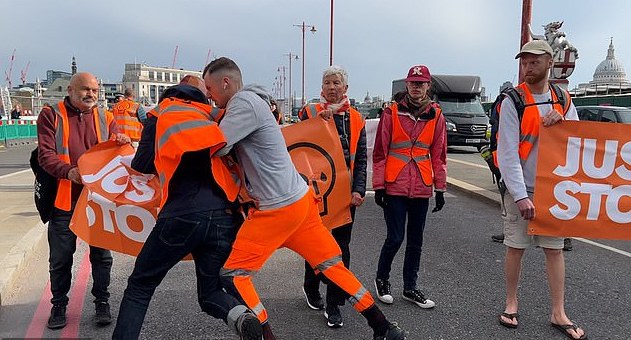
A Just Stop Oil campaigner attacked by an irate driver on Waterloo Bridge last week.
For those of us who were around at the time of the Battle of the Beanfield, or who have faced the impacts of authoritarian legislation in the decades since, the words ‘Public Order Act’ can only ever be discomforting. However, as Just Stop Oil campaigners, undeterred, have continued to test the resolve of the police by slow marching every day in central London since the new Public Order Act was passed, I’m sure all of us are fully supportive of their actions.
They, after all, are only demanding what the government is supposedly committed to as part of its climate obligations under the 2015 Paris Agreement — ending all new oil and gas. They, and not the protestors, are the extremists — the terrorists, one might even say — and, as was the case in 1985, the “small, mild mannered bunch of people” out on the roads are the ones who deserve our support, not the sociopaths and criminals in the government.
Posted in.|Taggedbeanfield, festival, free, law, police, stonehenge, travellers, worthington|Comments Off on Hatred of Dissent: Reviewing Four Decades of Repressive Tory Laws on the 38th Anniversary of the Battle of the Beanfield – Andy Worthington
17 Exercise of police powers in relation to journalists etc
(1)A constable may not exercise a police power for the sole purpose of preventing a person from observing or reporting on a protest. (2)A constable may not exercise a police power for the sole purpose of preventing a person from observing or reporting on the exercise of a police power in relation to— (a)a protest-related offence, (b)a protest-related breach of an injunction, or (c)activities related to a protest. (3)This section does not affect the exercise by a constable of a police power for any purpose for which it may be exercised apart from this section. (4)In this section— “injunction” means an injunction granted by the High Court, the county court or a youth court; “police power” means a power which is conferred on a constable by or by virtue of an enactment or by a rule of law; “protest-related breach”, in relation to an injunction, means a breach which is directly related to a protest; “protest-related offence” means an offence which is directly related to a protest.
This article first appeared in the Summer 2023 edition of Freedom
Nothing quite illustrates how a spark can seem to catch and then fail to reignite more than these two grim facts. Firstly, there are young people in prison in Britain today because they came onto the streets in 2021 and tried to prevent a harsh law restricting the rights of both protesters and of Gypsy, Roma and Traveller communities. Secondly, only two years on, Parliament has rubber-stamped the Public Order Act – another piece of anti-protest legislation containing all the most oppressive, most draconian changes the Conservative government failed to push through previously – with barely a whimper.
This is not meant to single out anyone for criticism. Stopping a government from passing laws when the ruling party has an enormous Commons majority was always, at best, unlikely, even when thousands protested against the Police, Crime, Sentencing and Courts Bill in 2021. We simply lacked the numbers and the momentum.
Knowing this should, however, give pause to everyone who devoted so much time and energy trying to lobby Tory parliamentarians with brilliantly worded arguments about the importance of human rights and the negative consequences of the proposed new laws.
Appealing to politicians did not work in 2021 and it has not worked to counter the Public Order Act. The Conservatives, now ideologically a far-right populist party and deeply authoritarian, simply have no interest in listening to reason.
Climate culture wars
The state has treated the right to protest with even greater intolerance than usual since the emergence and political challenge of new environmental civil disobedience movements like Extinction Rebellion in 2018.
This was accelerated by the Johnson government’s landslide election victory the following year and by the global pandemic, which led to the greatest restrictions on our human rights (and particularly the right to assemble) in generations.
I think sometimes we underestimate the profoundly negative effect that halting our ability to gather together, no matter how important this was at the time, has had on state attitudes towards protesters. Nor am I talking only about the police, who have always treated protests as a little more than a nuisance and who revelled in the opportunity that lockdowns provided to “impose order”. We saw that most graphically in the Metropolitan Police’s violent response to Black Lives Matter protests in London in 2020.
Government attitudes too have hardened against any sense that the right to protest is inherently valuable in a supposedly democratic society and this is certainly reflected in the legislation that has followed.
Woven into the government’s reaction to mass climate activism, is, of course, the desire to protect the fossil fuel industry. The focus for ministers has shifted towards more aggressively framing political debate over the consequences of inaction on the climate emergency into a populist cultural battle between “disruptive environmentalists” on the one side and “hard working citizens going about their daily lives” on the other (as though these were two entirely separate groups).
Restricting disruptive protests
The government has sought to restrict the right to so-called “disruptive” protest in three ways. Firstly, ministers want to severely narrow the idea of what is “acceptable” disruption that inevitably results from protests, to mean only the most minor inconveniences are considered legitimate.
Secondly, they are expanding police powers to offer senior officers what they might potentially find useful at some point, rather than on what is genuinely reasonable or proportionate (the standard for human rights compliance).
Thirdly, they are introducing new laws to criminalise the methods by which serious disruption might potentially take place, rather than focusing on the actual degree of disruption a protest could lead to.
In all cases, the importance of fundamental rights to freedom of assembly have been almost completely ignored.
The Police, Crime, Sentencing and Courts Act 2022 was the starting point: it enables the police to limit protests based on a vaguely worded and highly subjective decision about whether they were too noisy. It is significant that over the last year, this power has not yet been used. Instead, the police have relied heavily on another part of the new legislation, the revised offence of “public nuisance”. This was hardly ever used against protesters in the past but is now more often the preferred charge, instead of “obstruction of the highway”, for blocking roads. This is because it has proven the most convenient way to shut down protests. Usually, this involves little thought about the so-called “balance” between demonstrators and the rights of others and it has enabled the detention in prison of a record number of campaigners, the largest number in decades.
New disruption offences
The new Public Order Act, meanwhile, creates a number of new offences related to disruption, particularly directed against business or corporate interests. These include “obstruction of major transport works” like road building or “interference with key infrastructure” such as oil or gas exploration – had the law been in place before, it would undoubtedly have applied to protests at fracking sites. The Act also creates a new criminal offence of “locking on” to another person or an object as part of direct action or civil disobedience tactics.
Now in every instance, there was already wide-ranging public order legislation in place for all these kinds of activities and under existing laws, arrests were already made and prosecutions already brought. So why create new offences?
Primarily this is because they carry much tougher sentences on conviction, including imprisonment. It is also easier to convince a court to remand detainees or impose restrictive bail conditions. However, it also helps to justify the introduction of new police powers to stop and search anyone suspected of going to commit an offence of obstructing the highway, or public nuisance, or any of the new offences in the Public Order Act.
The greater severity of new offences also provides a pretext for targeting a few key organisers with another alarming part of the Act – Serious Disruption Prevention Orders. These are essentially anti-protest banning orders that can prevent an individual from associating with named others, going to certain areas or attending protests. It may mean anyone who has an order imposed on them is required to wear an electronic ankle tag as part of its enforcement.
These are civil orders, so courts will be able to decide, on the balance of probabilities (the civil standard of proof, not “beyond reasonable doubt”), that an individual is likely to cause disruption – based solely on intelligence from the police.
The threat of intrusive surveillance
The impact of intrusive intelligence-gathering has long been recognised as having a possible “chilling effect” on whether people feel able to go out and protest. This is particularly an issue in Britain because surveillance is at the core of the police’s approach to protests. There is, after all, an ongoing public inquiry into spying by police units on campaigners over many decades.
Surveillance is always rationalised by the labels the police apply to those who are targeted: agitator, subversive, extremist. In Britain, the new label, as Netpol is now trying to highlight, is “aggravated activist”.
In 2019 at a “protest round table” the Home Office said police had identified “circa thirty environmental activists who travel the country orchestrating protests and taking direct action” as the likely targets for new banning orders – a small number of largely pacifist protesters, although the number has most likely grown since then. We do not know exactly how many, because the police say it will cost too much money to provide Netpol with a figure.
The government wants to convince us that Serious Disruption Prevention Orders will impact a very few hardcore “aggravated activists” and that the wider movements that these targeted individuals are a part of have nothing to fear.
In order to build a case for imposing banning orders, however, officers will seek to gather intelligence on hundreds of people in the movements their targets are part of, on the people they know and on the places they work, even if they personally have never committed any kind of unlawful activity.
So on top of new, more severe offences and even more new police powers, the Public Order Act represents a massive increase in police surveillance. It is about criminalising entire movements, particularly environmental campaigners, with the intention of sending a warning to protest movements that civil disobedience tactics – in any circumstances – are liable to result in an aggressive response from the police.
That is the danger for us all – that regardless of what the law says, any protest seen as “disruptive” will face more oppressive policing.
Defending dissent
None of this means that protest is now illegal, but it has become a lot more uncertain.
This is why Netpol’s priorities are much less on the passage of legislation through Parliament or efforts to amend government bills and instead are focused on creating the conditions to challenge the spread of uncertainty once new laws are passed. As campaigners and as movements, we can all help to do this, in four ways.
Firstly, by making sure everyone knows their rights – because knowing what powers the police have gives people enormous confidence to challenge their misuse on the streets.
Secondly, by resisting police surveillance – which means better protection for the members of our movements most likely to face such targeting and a greater awareness of the basic security practices which can help us challenge police intelligence gathering.
Thirdly, by getting better at offering more practical solidarity – so trying to avoid seeing ourselves in isolation from other campaigns and understanding that the threat of oppressive policing falls on all of us, so we better start offering solidarity to each other, even if we disagree on tactics.
And finally, it means actively monitoring what is happening around the country. Netpol needs your help to know when new powers are used and in what circumstances so we can build a case for why we believe they exist primarily to disrupt and further criminalise the right to dissent.
We have an encrypted monitoring form and a number to send us information via Telegram/Signal. You can find more information on our Defending Dissent campaign at netpol.org/defend-dissent
The following measures in the Public Order Bill will commence on 3rd May 2023:
the definition of serious disruption in the Public Order Bill
locking on
going equipped to lock on
interference with key national infrastructure
amending the seniority of police officer in London who may attach conditions to an upcoming protest or prohibit a trespassory assembly to match that applicable in forces outside of London
Protection of journalists
This measure establishes a safeguard for journalists by specifying that the police cannot use their powers solely to prevent a person from reporting on or observing protests.
The police can still lawfully exercise their powers, for example of arrest or to maintain public order and public safety, for other legitimate purposes.
A new clause (amendment 54) protecting journalists, legal observers, academics, and bystanders, was added to the bill. The amendment was brought forward following backlash against journalists recently arrested in Hertfordshire while covering a JustStopOil protest on the M25.
The clause states that there will be a protection for journalists and others monitoring protests and that a police officer may not exercise any police power to prevent that person from observing or otherwise reporting on the protest or any activities related to the protest.
Nigel Dickinson of the Photographers’ Council said there was a continued lack of understanding by some police forces and their officers of the rights of journalists and photographers.
Delegates commended the excellent work conducted by the union to build relationships with the police, judiciary and the security industry, but called for urgent action to address continued problems encountered by reporters and photographers.
In particular conference expressed concern about the unacceptable arrests of those covering the ‘Just Stop Oil’ protests. Proposing the motion, Nigel Dickinson of the Photographers’ Council said there was a continued lack of understanding by some police forces and their officers of the rights of journalists and photographers. There were numerous examples of members being obstructed and there was a need to widen engagement with police forces, he said.
Seconding the motion, senior organiser David Ayrton, said the issue should not be seen as separate from debates on the pay of journalists because it was about the capacity of members to earn a living without being harassed.
Under the terms of resolution, the NEC was instructed to re-engage with the National Police Chiefs Council and the College of Policing to further inform and educate police officers. It was further instructed to seek information from the NPCC and CoP and each police force to establish what guidance is available to officers in dealing with photographers at a crime scene and in public places generally.
Under the composite motion, chapels and branches are to be assisted to improve relationships with police. Existing work by the union had already resulted in the speedy resolution of problems and the development of new training procedures.
Conference noted the union’s participation in the Ministry of Justice’s Media Working Group helping to draw up a Reporters’ Charter applicable to all courts in England and Wales, setting out journalists’ rights to attendance, access to documents and notice of proceedings. The union had also agreed guidelines with the Professional Security Association which were now widely adopted within the industry which aimed at removing points of conflict.
Following consultations with the union, the London Metropolitan Police had drawn up guidance which explains the rights of journalists. Discussions between Bristol branch and Avon and Somerset Police had improved the knowledge of officers on the role of journalists.
An amendment to the motion, calling for the use of the Freedom of Information Act to discover the attitude of police forces, was defeated. Delegates argued that it would ‘not be helpful’ to the relationship with the police and that the FoI should be kept as a back-up.
As part of DM’s examination of relations with other organisations, conference narrowly passed a resolution calling on the NEC to consult the membership about the union’s contact with Google. The NEC argued that the union’s contact with the organisation over training in particular was invaluable. But the motion, tabled by London Freelance Branch, said serious concerns had been raised by branches about the significant copyright, reputational and ethical damage the NUJ’s partnership with the organisation brought. The resolution said that any existing relationship with Google should be terminated if necessary.
For heaven sake! I have been blocked for 24 hours from posting on Facebook because I had uploaded this image. Now I know the ‘community guidelines’ go on about nudity and sexual activity etc ….. but if anyone sees rudeness or unacceptable behaviour in this image …. then I think something is wrong with them, not me. But I guess a human hasn’t seen it, it is the way the algorithm is set up. I wrote to them of course to appeal, but as far as I know, they never write back!
This is at the Norwich – Eaton by the River Festival, August 1980. How on earth do you tell the story of the early free festivals without the kids roaming free and with freedom?
Peers voted to add a new clause stating that officers may not exercise any police power for the purpose of preventing someone from observing or reporting on a protest or the exercise of police powers in relation to a protest-related offence.
Labour peer Baroness Chakrabarti, who led the amendment alongside Liberal Democrat peer Lord Paddick and crossbencher Lord Hope, said it was “totally uncontroversial” to protect journalists from the “abuse of police power”.
Legal observers, academics and bystanders who observe or report on protests would also be protected by the amendment. The Government opposed the amendment but it was voted for by 283 to 192, a majority of 91.
Boycott, a former editor of The Independent and the Daily Express, said: “Charlotte, like Ed Lawrence was handcuffed for doing her job. She was held in a cell with a bucket for a toilet for five hours; she was fingerprinted and her DNA was taken, and she was not allowed to speak to anyone. Her arrest took place just two weeks before Ed Lawrence’s. Is this the kind of world we want to live in?”
Boycott said the right to protest is a “fundamental right” and that it is a “duty” for journalists to report on them “because demonstrations are where we see where society is fracturing and where people really care.
“I cannot believe, as a former newspaper editor, that I would now have to think that it might be more dangerous to send a journalist to Trafalgar Square than to Tahrir Square [in Cairo, Egypt].”
Similarly, Conservative peer Lord Patten, the last British governor of Hong Kong, said: “It is astonishing that we are proposing in this country the sort of thing which we would denounce if the Chinese Communist Party were doing it in Hong Kong.”
Lord Hope cited Article 10 of the European Convention on Human Rights, which protects the right to freedom of expression.
He added: “It may be suggested that the point being made by the amendment is so obvious that it is unnecessary, but I simply do not believe that.
“In the highly charged atmosphere of the kind of public protest we are contemplating in these proceedings, it is too big a risk to leave this without having it stated in the bill and made part of our law.”
Conservative peer Lord Garnier agreed, adding: “If we are not careful, we will move to preventing the media from creating fair and accurate reports of our courts and even of this place.”
However Lord Hogan-Howe, the former Metropolitan Police commissioner, objected to the amendment, saying that although it is “very obvious” a journalist should not be arrested for doing their job, the bill would mean they could only be challenged for illegal behaviour.
He added: “There is no general defence of being a journalist to any criminal offence. There is protection of legally privileged material, including journalistic material, and the Police and Criminal Evidence Act provides quite proper protection for that.
“However, that is not the same as providing a general defence for criminal behaviour to a journalist. In my view, that is what this proposes.”
Hogan-Howe also said that police may struggle to define the non-journalists covered by the amendment, saying: “An observer, somebody who is monitoring: how are the police to know who these people are? I guess that as soon as a protester is challenged, they might decide that they are a monitor, an observer or any of the groups that might be protected.”
He added: “Journalists complain that many people now claim to be journalists but are merely reporting online. Is that group included in this definition as well?”
The Green Party‘s Baroness Jones, whose daughter is a journalist, pointed out in response that accredited journalists have press cards. She also said: “I do not see why anyone here would have a problem with it, except the Government. What are they frightened of? What do they think journalists will report that would look so bad for them? Obviously, almost anything.”
The peers also debated whether it was necessary to introduce legislation covering something that is already unlawful, but as Lord Paddick put it: “…the fact is that Charlotte Lynch was taken out of the game for five hours and detained in a police cell, where she could not observe what was going on. We need upfront protection for journalists and observers, and not to rely on a defence that they can put after they have been handcuffed, arrested, and put in a police cell even though they are in possession of a police-accredited press pass.”
The bill, with the new amendment, will now return to the House of Commons. Lynch said following the debate: “It’s vital journalists are not deliberately prevented from reporting on legit protects. We don’t get to decide the facts, our job is just to give them to you. I hope this amendment continues to receive support.”
✨ Protection for journalists! ✨
Thrilled to have been in the House of Lords tonight to see Public Order Bill amendment pass with majority of 91, to ensure protection of journalists reporting on protests. Thank you to Baroness Chakrabarti for tabling it following my arrest. pic.twitter.com/uwYk5dT1go— Charlotte Lynch (@charlotterlynch) February 7, 2023
An ongoing diary of stuff, allsorts, and things wot happen ……
I am a photographer with a special interest to document the lives of travelling people and those attending Festivals, Stonehenge etc, what the press often describe as ‘New Age Travellers’ and many social concerns.
With my photography, I have tried to say something of the wide variety of people engaged in ‘Alternatives’, and youths’ many sub-cultures and to present a more positive view.
I have photographed many free and commercial events and have, in recent years, extended my work to include dance parties (’rave culture’), gay-rights events, environmental direct actions, and protest against the Criminal Justice Act and more recently, issues surrounding the Global Capitalism.
Further, police surveillance has recently become a very important subject for me!
In recognition of this work, received a ‘Winston’ from Privacy International, at the 1998 ‘Big Brother’ Awards. The citation reads: “Alan Lodge is a photographer who has spent more than a decade raising awareness of front-line police surveillance activities, particularly the endemic practice of photographing demonstrators and activists”.
I am based in Nottingham, UK.
Quotes & Thoughts
“Cowardice asks the question, ‘Is it safe?’ Expediency asks the question, ‘Is it politic?’ Vanity asks the question, ‘Is it popular?’ But, conscience asks the question, ‘Is it right?’
And there comes a time when one must take a position that is neither safe, nor politic, nor popular, but one must take it because one’s conscience tells one that it is right.”
Martin Luther King Jr.
“In Italy for 30 years under the Borgias they had warfare, terror, murder, and bloodshed, but they produced Michelangelo, Leonardo da Vinci, and the Renaissance.
In Switzerland they had brotherly love – they had 500 years of democracy and peace, and what did that produce? The cuckoo clock!!”
Harry Lime [Orsen Wells] The Third Man 1949
“Civilization will not attain to its perfection, until the last stone from the last church, falls on the last priest.”
Emile Zola
“….I have an important message to deliver to all the cute people all over the world.
If you’re out there and you’re not cute, maybe you’re beautiful, I just want to tell you somethin’- there’s more of us ugly mother-fuckers than you are, hey-y, so watch out now…”
Frank Zappa




 Tash on YouTube

