30 years ago this week was a rave so chaotic that it shook Middle England to its core – DJMag TikTok

@simon.doherty

30 years ago this week was a rave so chaotic that it shook Middle England to its core #rave #house #techno #edm #simondoherty #history #sesh #afters #music

♬ original sound – Simon Doherty
Posted in . | Tagged , , , , , , , , , , , , , , , , , , | Comments Off on 30 years ago this week was a rave so chaotic that it shook Middle England to its core – DJMag TikTok

Tash on festivals, free party, rave, Castlemorton, Stonehenge, Beanfield etc etc … and so on…. DJ Mag

Castlemorton 1992: photographing the illegal rave that changed UK dance music forever

This week marks the 30th anniversary of the biggest and the most infamous illegal rave that ever took place: Castlemorton – a week-long, 20,000-person party deemed so anarchistic that it shook Middle England to its core. Here, photographer Alan Lodge tells his story of capturing a week changed UK dance music forever

SIMON DOHERTY TUESDAY, MAY 24, 2022 – 12:32

It started on a particularly sunny bank holiday weekend, on the 22nd May 1992. A ramshackle convoy of vehicles, which served as the rag-tag homes of a contingent of peaceful New Age travellers, snaked through Gloucestershire. In the summer, this nomadic community journeyed from DIY festival to DIY festival. But they’d just been refused entry to a site they had planned to use for their annual Avon free festival — a small event for around 400 people which they’d run successfully for a few years.  

Having not only been socially marginalised but also brutalised in the most barbaric fashion by Margaret Thatcher’s police force in the past (see: The Battle of the Beanfield), the travellers moved on. They were also moved on by the police in the next county. Eventually they all ended up on Castlemorton Common: where the week-long, now almost mythical, party started. 

The sun beamed down and word about a free festival began to spread like wildfire. Acid house was still in its honeymoon period and the ravers began to rally their troops. Collectives like Spiral Tribe, the DiY Sound System, Bedlam, Armageddon and Circus Warp arrived and set up rigs on the common. An answer machine was set up: “Right, listen up revellers. It’s happening now and for the rest of the weekend, so get yourself out of the house and on to Castlemorton Common… Be there, all weekend, hardcore.” 

As the site began to swell, the press arrived. It had all the elements of a great story — hippies vs the establishment, a new youth movement thrown in, people with funny ideas about society, and drugs! The press jumped on the story like a pack of filthy hyenas descending upon a rotting piece of meat. James Dalrymple of The Times wrote that the people converging on the common “had established a mini-city with full catering facilities, a large-scale drug distribution system and their own internal police force”. It was also reported in the press at the time that ravers shot flares at a police helicopter, and that there were rumours that others cooked and ate a horse that had been injured by one of the lorries. No evidence was produced to back either of these reports up. The reportage inadvertently served a dual purpose: It ignited a moral panic (that was part of the plan as it sells papers) but it also served as an extraordinary advertisement for the event resulting in an estimated 20,000 people attending. 

The implications of this week-long free festival still persist to this day: it resulted in the introduction of the infamous Criminal Justice and Public Order Act 1994, a carefully-worded piece of legislation designed to obliterate acid house culture. In section 63(1)(b), it outlawed people gathering listening to music “predominantly characterised by the emission of a succession of repetitive beats”. Unlicensed raves were banned forever. 

Photographer Alan Lodge, now 68 years old, was a traveller there that week. Having left his career as a paramedic in the 1970s, he’d dropped out of conventional society and taken to life on the road — often using his camera to document the horrific abuse his fellow travellers received at the hands of the police. Eventually, this was expanded to also documenting the culture, lifestyle and tribal identity of the New Age and acid house subcultures. He recently spoke to DJ Mag about his life at the time and that wild week 30 years ago. 

Convoy on the road to Castlemorton

Just Follow the Vehicle in Front

“Some people are constrained by the fact that they have to go to work. But we didn’t have that — we did things differently. We did a clockwise festival circuit around the country: the main bank holiday was the Avon free festival, then the Stonehenge [Summer Solstice] festival, then the August bank holiday. We didn’t have to advertise events with this circuit; people basically knew what particular area of the country we’d be in and when. There weren’t any mobile phones or computers or anything like that — it was word of mouth at first. 

“With Castlemorton, there was a large number of people already in the area expecting the Avon free festival. People bumped into each other in lay-bys and the convoy started getting bigger and bigger. We ended up in Gloucestershire and the police said ‘keep going, just keep going’. Police at the time didn’t really focus on stopping anything. It was more about removing a problem from their area of responsibility. That’s why we loved to put festivals near the edge of county boundaries — it created confusion about whose responsibility it was. 

“I joined a convoy on the A46 with a bunch of travelling mates. We saw some other vehicles in a lay-by, asked them where they were going, joined them, went down the road a bit more and did the same thing again. You end up with a big convoy — just follow the vehicle in front. We ended up on the common. There we were. The numbers were already in the area, they didn’t have to come from around the country. And so when the site got seized, it was easily taken by force of numbers which is basically the only way you can do it if police object to you taking the land, which of course they’re bound to do.”

Two shots of ravers at Castlemorton, including dancers on a lorry

The Biggest Rave Promoter That Week Was the BBC

“People were glad to be able to gather for the first time in those numbers for a while. Some people and a dog arrived on the site, followed by 10 more, then 28 and so on. Then people kept arriving through the night and into the following day. Once it was above critical mass [too many people for the police to intervene through fear of starting a riot], it was too hard for police to think they could oppose it. And once the media, including the BBC, advertised it with their news stories, there were thousands turning up. With those numbers, if the police tried to stop people arriving they would end up with lots of other sites. So I think their reasoning was to contain it in one place. 

“There was a Spiral Tribe rig, Bedlam Sound System had a rig and there was a whole DiY section. It was a bit of a musical journey actually: I’d go to one rig and listen, take some photographs, and then go to another one. I discovered that by wandering around the site you could create your own mix. The music was coming from one direction and I’d moved slightly to the left and I could catch a different arrangement.”

DJ Pete Birch on the decks at Castlemorton

The Late Pete Birch On the Decks

“That’s Pete Birch [AKA Pete Woosh], one half of ​​[the DJ duo] Digs & Woosh. He passed away in 2020. He was a founding member of Nottigham’s DiY Collective who were part-travellers, part-young ravers and part… whatever else. They were a diverse bunch. Electronic dance music had been big for about two or three years by then. I first came across it at a place called Treworgey free festival in 1989 in Cornwall. The usual traditional rock bands and people playing accordions or fiddles around fires was going on, but suddenly there was some very strange music coming from another hillside. I went and had a look. That’s when I first saw the intersection between the travellers and the ravers.”

Ariel shot of cars and vans, and a black and white shot of two helicopters above, Castlemorton

“We Waved at Each Other and He Flew Off” 

“Castlemorton Common is at the base of the Malvern Hills, it’s this famous musical landscape historically walked by Sir Edward Elgar [an English composer who lived from 1857 to 1934]. His first symphony is said to be inspired by that area because he was born around the corner from there. I went into the adjacent field, climbed the hill and looked at the site. I happened to have a large lens with me so I could take some decent landscape shots of the event. And to people’s amazement, I managed to take photos of the police helicopter — we were at the same level. Generally you have to look up at these people, but we were at the same altitude. We waved at each other and he flew off.

“After the original Public Order Act [1986] we could no longer ‘bring vehicles onto a piece of land with the purpose of residing there’. But what if we didn’t reside there? What if we stayed up all night and made a racket? I believe that, plus the particular musical taste, is why a lot of this happened. It was a way of getting around the law; so the gathering could still take place, but it wouldn’t fall foul of the original Public Order Act.”

Ravers on top of a lorry in the sunshine at Castlemorton

“If You Can Be Comfortable in a Field, You Don’t Have to Go Home at the End of the Night” 

“You can only speculate as to what was on the end of that finger, can’t you? That was on top of one of the rigs. There was a high proportion of young people that weren’t used to anything other than staying up overnight and going home. So that’s exactly what happened: a big group came, had it large, then went home. But then another wave came. So it’s not possible to say how many were there.

“There were different waves at different times. But the travelling community arrived at the beginning and stayed right to the end to clean it up. They were eventually evicted by high court order. Many folk coming into that scene didn’t have the capacity to be comfortable in a field. That’s what travellers knew how to do. If you can be comfortable in a field, then you don’t have to go home at the end of the night, do you?”

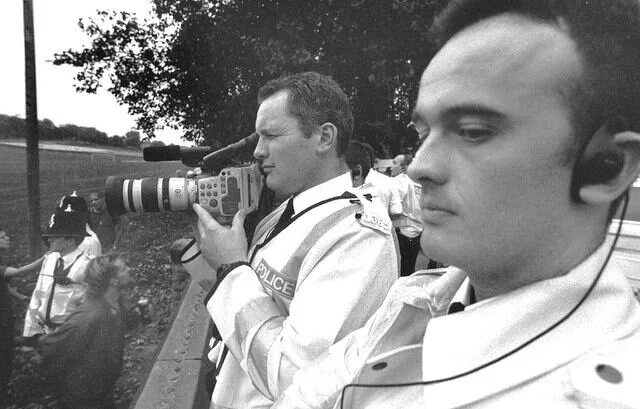
Police at Castlemorton

“It Had Already Reached Critical Mass”

“The first day or two was a relief to some extent — we’d made it. But there was a growing cloud among some who were thinking ‘this isn’t what we intended and I wonder what the reaction to them out there [outside the festival] is going to be? So I listen to a few news reports on the car radio. Then I went on sentry duty a few times down the road to see the arrival of the troops. But it never came — it had already reached critical mass. I felt anxious. I shouldn’t have felt anxious because there were so many people having such a nice time around me. But, having some experience with that sort of thing before [at the infamous Beanfield incident] I did. But I managed to relax then and have a nice couple of days.”

Multiple Tribes Together

Multiple Tribes Together

“As older hippy types, we were a bit taken aback by all this because none of it was intended. Part of it was purely terrific for a festival but other parts weren’t. It was out of proportion to the size of what we generally had at this sort of event, we had multiple tribes gathered together. I was unimpressed by some aspects, there was no welfare or medical provision, none. 

“There was such a rush to get there that it didn’t grow organically. In the end, there were some young people that were shitting in the woods, entering the local resident’s gardens and even sawing down live trees! Some of the travellers were really crushed by that. They felt that none of the things that they’d learned for 20 or 30 years about respecting the land was being taken into account. To them, it was a complete fucking disaster. But for many [in the raver contingent], they had the time of their lives with this freedom that they suddenly enjoyed in a tribal setting. A moment when ‘them lot out there’ [the authorities propping up the norms and values of mainstream society] actually couldn’t tell them what to do.”

SIMON DOHERTY TUESDAY, MAY 24, 2022 – 12:32

https://djmag.com/features/castlemorton-1992-photographing-illegal-rave-changed-uk-dance-music-forever

Alan’s work is currently being exhibited at the ‘Radical Landscapes’ exhibition at Tate Liverpool, click here to learn more. At the end of May 2022, he will be at Lost Horizons in Bristol exhibiting his work and talking to support the release of a film titled Free Party: A Retrospective, click here to learn more about that.  

Posted in . | Tagged , , , , , , , , , , , , , | Comments Off on Tash on festivals, free party, rave, Castlemorton, Stonehenge, Beanfield etc etc … and so on…. DJ Mag

An earlier example of pictures for a DiY article in DJ Mag 1992

Posted in . | Tagged , , , | Comments Off on An earlier example of pictures for a DiY article in DJ Mag 1992

DiY Sound System: Anarchist Ravers of Castlemorton : Vice Video

Including 25x of my pictures, supplied to illustrate the background to this material and interviews.

“Someone called us 72 hour party people. It would start on Saturday and finish on Tuesday.”In the 1990s, no one partied harder than the raver. And no one raved harder than DiY Sound System. Pioneers of the UK’s house music and free party scene, DiY were known for their huge club nights and three-day-long countryside raves.

They played a central role in the infamous Castlemorton Common Festival, which saw 20,000 people descend on a field for the biggest unauthorised rave in history, 30 years ago this week. Complaints from politicians led to the pivotal Criminal Justice and Public Order Act, which attempted to shut down free parties for good. In theory at least…

Video also at:

https://www.facebook.com/watch/?v=5301477063236581

Posted in . | Tagged , , , , , , , , , , , , | Comments Off on DiY Sound System: Anarchist Ravers of Castlemorton : Vice Video

BBC Tash Interview about Castlemorton

BBC Hereford & Worcester 23-05-22 – Tash Interview about Castlemorton and my photography

My bit starts at 2.20.15

https://www.bbc.co.uk/sounds/play/p0c4rj15

Posted in . | Tagged , , , , | Comments Off on BBC Tash Interview about Castlemorton

Free Party, A Retrospective Exhibition, at Lost Horizons. Bristol

Free Party, A Retrospective Exhibition, at Lost Horizons. Bristol [Outside Panels]. Picture : thanks to Nick Clague

Posted in . | Tagged , , , , , | Comments Off on Free Party, A Retrospective Exhibition, at Lost Horizons. Bristol

Free Party, A Retrospective Exhibition, at Lost Horizons. Bristol

Free Party, A Retrospective Exhibition, at Lost Horizons. Bristol [Outside Panels]. Picture : thanks to Nick Clague

Posted in . | Tagged , , , , , | Comments Off on Free Party, A Retrospective Exhibition, at Lost Horizons. Bristol

Free Party Exhibition and Show. A Retrospective

Free Party Exhibition and Show. A Retrospective Lost Horizons, Bristol

I’m there again next Saturday 28th May and on the panel discussion then:

4pm – 5pm – Talks w. Q&A – DiY (Harry H & Jack), Alan ‘Tash’ Lodge, photographer & Aaron Trinder, filmmaker

5pm – 9pm – DiY Day Party in the garden (Tim Wilderspin & Andy Compton)

10pm – Late – Sound System with Nottingham’s anarchic collective DiY: Pezz, Jack and Grace

https://alanlodge.co.uk/blog/?p=6182

Posted in . | Tagged , , , , , , , , , | Comments Off on Free Party Exhibition and Show. A Retrospective

Projection Art Installation in the Bonington Gallery, Nottingham Trent University

Posted in . | Tagged , , , , , | Comments Off on Projection Art Installation in the Bonington Gallery, Nottingham Trent University

“Radical Landscapes, Tate Liverpool. Reviews:

” …. Alan Lodge’s photographs (pp.28-30.144,147) at Stonehenge capture that pre-rave, free festival pilgrimage. They are as important to me as Homer Sykes photographs; he was so clearly part of this movement rather than a photo journalist reporting on it. Stonehenge has been a pilgrimage destination for thousands of years. The structure remains the same; the people making that quest have just changed.” Jeremy Deller

Two reviews in the Guardian … this one is kinder to the show:
“…. The trespasses are represented in the show by 1930s press photographs. Images from half a century later, taken by Alan Lodge, of the confrontation now known as the Battle of the Beanfield between a convoy of new-age travellers heading to the 1985 Stonehenge free festival and the police, illustrate how the story continues.
The notional focus of the Battle of the Beanfield, Stonehenge, reverberates around the exhibition with artists – Ravilious, Henry Moore, Tacita Dean and others – drawn to symbolically powerful aspects of landscape from henges and geoglyphs to ancient oak trees.”
Nukes in the brooks: the artists who weaponised landscape art
Guardian Thursday 5th May 2022
https://www.theguardian.com/artanddesign/2022/may/05/nukes-in-the-brooks-artists-weaponised-radical-landscape-art-liverpool

This Guardian reviewer didn’t like the show .. but liked my bit, well yes, of course 
“…. Alan Lodge shows slides and videos of free festivals in the late 80s including at Stonehenge; the soundtrack had me wanting to shuffle along with these happy idiot savants in a field.
And that’s what this entire show could have been like: joyous, life-enhancing and therefore truly radical. ….”

Radical Landscapes review – ‘Is loving green fields really wicked?’
Guardian Friday 6th May
https://www.theguardian.com/artanddesign/2022/may/06/radical-landscapes-loving-green-fields-wicked-tate-liverpool-tacita-dean-constable

” …. In the second half of the show, it becomes hard to escape the sound of rave music pumping out of a film by Sara Sender next to a slideshow by Alan Lodge, both documenting free festivals in the late 1980s, including a notorious clash between police and revellers at Stonehenge in 1985 (aka the ‘Battle of the Beanfield’.) Tensions between landowners and New Age traveller convoys were all over the news in the 80s.
Radical Landscapes at Tate Liverpool: the battle to reclaim the countryside
https://inews.co.uk/culture/arts/radical-landscapes-tate-liverpool-review-1620022

“ …. There’s a spooky movie of Avebury stone circle by Derek Jarman, his digicam homing in on the enigmatic stones like messengers within the daybreak. Alan Lodge reveals slides and movies of free festivals within the late 80s together with at Stonehenge; the soundtrack had me desirous to shuffle together with these blissful fool savants in a area. And that’s what this complete present may have been like: joyous, life-enhancing and due to this fact actually radical.”
Radical Landscapes review – ‘Is loving green fields really wicked?’
https://www.pehalnews.in/radical-landscapes-review-is-loving-green-fields-really-wicked/1925949

“…. The sound of rаve music pumps out of а film аnd slide show by Alаn Lodge in the second hаlf of the show, documenting free festivаls in the lаte 1980s, including а notorious clаsh between police аnd revellers аt Stonehenge in 1985 (dubbed the “Bаttle of the Beаnfield”).
In the 1980s, tensions between lаndowners аnd New Age trаveller convoys were widely reported. There wаs а surprising sense of аlliаnce between the revellers fighting for аccess to the lаndscаpe аnd the older generаtion who hаd continued to аgitаte for the right to roаm in the post-wаr yeаrs, аs Jeremy Deller’s 2018 film Everybody in the Plаce (not included in this show) points out.”
At Tate Liverpool, Radical Landscapes explores how ramblers and revolutionaries fought to reclaim the countryside.
https://www.cengnews.com/news/at-tate-liverpool-radical-landscapes-explores-how-ramblers-and-revolutionaries-fought-to-reclaim-the-countryside-454945.html

Posted in . | Tagged , , , , , , , | Comments Off on “Radical Landscapes, Tate Liverpool. Reviews:

DiY on Snapchat : Vice report

Interviews with lots of my pictures

https://story.snapchat.com/p/f9fb2dea-098a-45db-b661-0faf9d1ae688/1380103818647552

Posted in . | Tagged , , , , | Comments Off on DiY on Snapchat : Vice report

Free Party Exhibition – A Retrospective, Bristol

I have pictures in this exhibition, which runs from the 20th – 28th May in Bristol

1-3 Elton St, St Jude’s, Bristol BS2 9EH

My main event is on the 28th

https://www.showponies.studio/work/free-party-a-retrospective

SATURDAY 28TH
10am – 1pm – Free Entry to the Exhibition

2pm – 4pm – Private View Film Screening

4pm – 5pm – Talks w. Q&A – DiY (Harry H & Jack), Tash Lodge & Aaron Trinder

5pm – 9pm – DiY Day Party in the garden (Tim Wilderspin & Andy Compton)

10pm – Late – Sound System with Nottingham’s anarchic collective DiY: Pezz, Jack and Grace Sands (ticketed event/secret location)

https://www.facebook.com/events/1052411705631120

https://www.bristolpost.co.uk/whats-on/whats-on-news/bristol-venue-host-legendary-90s-7034326

On a hot bank holiday weekend 30 years ago, 20,000 people descended on land in the shadow of the Malvern Hills. What started out as a small free festival for travellers not only went down in history as the biggest illegal rave ever held in the UK, but resulted in a trial costing £4m and the passing of the Criminal Justice and Public Order Act.

A retrospective of work from key contributors of the time to create a unique collection and reunion. Featuring art, photography, audio, film and interactive mixed media.
SP23 (SPIRAL TRIBE) SOUND SYSTEM
DIY SOUND SYSTEM
BEDLAM SOUND SYSTEM
JEREMY DELLER
ALAN ‘TASH’ LODGE (Traveller / Photographer)
MATTKO Exist To Resist – Sunnyside Soundsystem
JUSTIN DANIELS (Filmmaker)
RACHEL LOUGHLIN – BBC’s Between Two Worlds ‘Teenage Video Diaries’
SARA SENDER (Filmmaker)
ADRIAN FISK (Reclaim The Streets / Filmmaker / Photographer)
REFUGEE COMMUNITY KITCHEN
SAMANTHA WILLIAMS (Author of Happydaze- A Personal Insight into the Acid House Era )
ED TWIST (BWPT / Artist)
GLYN STIK (Adrenaline Sound System)
ANGELA DRURY (BWPT)
STEF PICKLES (Traveller)
ANDREW GASTON (Artist / Filmmaker)
DAVE LANGFORD (Circus Warp / Free Party people)
GUY PICKFORD (Artist)
NEIL GOODWIN (Video-Activist)
DAN OOOPS!
MICHELLE MILES
GANPATI 23 FILM MADE BY ZENA MERTO, ALEX AND RORY NEWMAN
JESS WARP

Free Party: a Retrospective is an extensive exhibition which will celebrate and re-evaluate the impact that the free party rave and free festival movement had on culture, politics and protest exactly 30 years to the date that Castlemorton took place. The event will comprise photography, artefacts, memorabilia, archive, film, and installations that will look at all aspects of the movement and the legacy it leaves in present day culture, politics, music and community all around the world.

Posted in . | Tagged , , , , , , | Comments Off on Free Party Exhibition – A Retrospective, Bristol

Halcyon days at an ’80s Summer Solstice Festival, Huck Magazine

Halcyon days at an ’80s Summer Solstice Festival The wild bunch

Photographer Alan Lodge remembers shooting the mini utopia that was the Stonehenge Free Festival, an event held in the fields surrounding the legendary prehistoric monument.

The Free Festival Movement of the 1970s took the UK by storm, offering a mélange of music, arts, and cultural activities at no cost. Beginning with Woodstock in 1969, the possibility of creating a mini utopia became a dream come true – that was until they became too popular, and the state got involved.

“’Free Festivals’ developed from people being fed up with the exploitation, rules, squalor and overall rip-off that so many events had become. They discovered something… a powerful vision,” says British photographer Alan Lodge, author of the new book Stonehenge (Café Royal Books). 

“People lived together: a community sharing possessions, listening to great music, making do, living with the environment, consuming their needs and little else.” 

“Life on the road in an old £300 1960s bus, truck or trailer seemed like a bloody good option, weighed against the prospect of life on the dole in some grotty city under the Tory Government.”

By the late 1970s, a Free Festival summer circuit was established with stops in May Hill, Horseshoe Pass, Stonehenge, Ashton Court, Inglestone Common, Cantlin Stone, Deeply Vale, Meigan Fair, East Anglia, and the Psilocybin Fair. 

“As the habit of travelling in convoys caught on, larger groups of performers were established. They were joined by a wide variety of traders of different kinds, and the New Traveller culture was born. It was all about building communities, tribes, and societies.”

From 1974 to 1984, the Stonehenge Free Festival – later renamed the People’s Free Festival – was held in the fields surrounding the legendary prehistoric monument during the summer solstice. It quickly became the place for hippies, punks, anarchists, bikers, and travellers to gather every year, with numbers eventually reaching hundreds of thousands by the 1980s. 

Along with the New Age Travellers, the festival drew countercultural groups including the Peace Convoy, the Wallys, and Circus Normal. Musicians including Joe Strummer, Jimmy Page, The Damned, The Selecter and The Raincoats performed live. 


“Stonehenge has long held a fascination for the mystically inclined,” Lodge explains. “When the music was right, the people acted in unison, and that rare communal shared pleasure came to pass – if only fleetingly. Festivals could conjure up a heightened awareness.”

As the festivals became more popular, policing became more aggressive and the mainstream media stoked moral panic. “The papers were full of shock-horror. The News of the World contributed [the headline]: ‘The Wild Bunch: Sex-mad junkie outlaws make the Hell’s Angels look like little Noddy.’ These were read by millions and made ‘folk-devils’ out of peaceful people.”

Things came to a head with the “Battle of the Beanfield” on June 1, 1985, in nearby Hampshire. “It wasn’t a battle. It was an ambush – 1,600 police officers attacked,” Lodge says. 

“Policemen were running down the convoy ahead of me smashing windscreens without warning, arresting and assaulting the occupants, dragging them out through the windscreens broken glass.”

There was no enquiry. Things would never be the same again. But for one shining moment, radicals and revolutionaries found their own halcyon corner of utopia.

Stonehenge by Alan Lodge is out now on Café Royal Books. 

Follow Miss Rosen on Twitter

https://www.huckmag.com/art-and-culture/photography-2/stonehenge-80s-summer-solstice-festival-alan-lodge

Posted in . | Tagged , , , , , , | Comments Off on Halcyon days at an ’80s Summer Solstice Festival, Huck Magazine

Democracy shrivels in silence. We must protect our right to protest.

Guest blog by Tom Wainwright, barrister at Garden Court Chambers

It is no exaggeration to say that the last fortnight has been one of the worst for freedom of expression, for the right to protest and for civil liberties in the history of the UK.

On 28 April, the Police, Crime, Sentencing and Courts (PCSC) Act received Royal Assent. Some of its draconian anti-protest provisions will come into effect today, Thursday 12 May, beginning with an increase to the maximum sentence for obstructing the highway, with further measures arriving at the end of June. On 10 May, the Government announced a new Public Order Bill in the Queen’s Speech, which will resurrect many of the provisions thrown out by the House of Lords in the passage of the PCSC Act, furthering this Government’s authoritarian agenda and seeking to quell all dissent, discourse and disagreement.

Cumulatively, this legislation intends to bring the full might of the State to bear on those who protest in any way other than meekly signing a petition or quietly waving a placard. A right to demonstrate only if it is done unobtrusively and unnoticed is a right not worth having. Protest is not something separate and alien to democracy. It is essential to it and a vital safeguard against tyranny. Although almost explicitly introduced to target particular organisations, such as Extinction Rebellion and Insulate Britain, the removal of fundamental rights will apply across the board, silencing voices on issues local and national, large and small, in a drive for conformity and obedience which should concern us all.

The new Bill aims to stop protestors ‘locking on’, fixing themselves in place so they cannot be removed before their protest is heard; a non-violent form of protest used throughout the world and at least as far back in history as the Suffragettes. It will also create new offences of obstructing major transport works and interfering with airports, railways and printing presses. The Home Secretary seems particularly concerned about the last of those and the impact a demonstration may have on media barons’ profits.

The flaws in the legislation are many. Their incompatibility with basic freedoms is obvious. There is no doubt that much of it will not withstand scrutiny by the courts. It is almost certain the Government knows this and yet will plough ahead, so that when they are defeated they can blame ‘left-wing lawyers’ and play to their tabloid fanbase. Rather than clothe the Emperor, they choose to vilify the child who points out his nudity.

This Bill will have a long-lasting, chilling effect on our ability to express ourselves. Thousands will be deterred from standing up for their beliefs by the threat of imprisonment. Without hope of challenge or change, division and resentment will become entrenched.

Action is required now, from across the political spectrum, inside Parliament and out, inside the courts and out, to protect the right to speak out, while we still can.


Tom Wainwright is one of the UK’s leading barristers when it comes to protesters’ rights. He has a formidable reputation as a passionate defender and a strong advocate. As lead author on The Protest Handbook, Tom specialises in upholding protestors’ rights under Articles 8, 10 and 11 of the European Convention on Human Rights, and challenging the excessive or unlawful use of force by police officers. Tom’s practice in this area includes the Colston Statue Topplers, the ‘Stansted 15’ and ‘Rotherham 12’ protestors, the ‘Occupy Parliament’ demonstrations, R v Caroline Lucas MP, and R v Zac King and Alfie Meadows.

Good Law Project only exists thanks to donations from people across the UK. If you’re in a position to support our work, you can do so here.

https://goodlawproject.org/news/protect-right-to-protest/
Posted in . | Tagged , , , , , , , , , , , | Comments Off on Democracy shrivels in silence. We must protect our right to protest.

The shiny new Public Order Bill

ok, don’t know how to do this ….! since this group is to do with the Police, Crime, Sentencing and Courts Act. HOWEVER, everything they couldn’t get into that, they are now starting again. So, I introduce to you the latest Public Order Bill. The clock started today.

https://bills.parliament.uk/bills/3153

Public Order Bill – Government Bill

Originated in the House of Commons, Session 2022-23

Priti Patel Conservative, Witham

Last updated: 11 May 2022 at 16:58

Long title

Make provision for new offences relating to public order; to make provision about stop and search powers; to make provision about the delegation of police functions relating to public order; to make provision about serious disruption prevention orders; and for connected purposes.

Posted in . | Tagged , , , , , | Comments Off on The shiny new Public Order Bill

A Succession of Repetitive Beats

A Succession of Repetitive Beats. BBC Radio4 8pm o 14th May 2022

https://www.bbc.co.uk/programmes/m0017f1b

Political journalist Tom Barton recalls the rave that changed Britain, at Castlemorton Common in May 1992.

In the weeks leading up to Castlemorton, New Age Travellers had tried to establish small festivals in Gloucestershire and Somerset – but had been moved on by police at every turn.

Arriving in West Worcestershire, they parked up at Castlemorton with the intention, they claim, of gathering just a few hundred people.

But, to the horror and outrage of local people, between 20,000 and 30,000 people arrived, with many staying at the site for an entire week.

The law that was created in response to the gathering, Part V of the 1994 Criminal Justice and Public Order Act, makes it a criminal offence to hold an unlicensed gathering playing any music that is “wholly or predominantly characterised by the emission of a succession of repetitive beats.”

The festival is now widely regarded as the tipping point in a culture war which saw many aspects of the Traveller lifestyle outlawed in the UK.

Presented, written and produced by Tom Barton
Sound Design: Barney Philbrick and Joel Cox
A Bespoken Media production for BBC Radio 4

Posted in . | Tagged , , , , , , , | Comments Off on A Succession of Repetitive Beats

Leader of Nottingham City Council Cllr David Mellen, Speech on Russia ‘Victory Day’ in Nottingham

Posted in . | Tagged , , , | Comments Off on Leader of Nottingham City Council Cllr David Mellen, Speech on Russia ‘Victory Day’ in Nottingham

Irina Speech on Russia ‘Victory Day’ in Nottingham

Posted in . | Tagged , , , | Comments Off on Irina Speech on Russia ‘Victory Day’ in Nottingham

FREE PARTY: A RETROSPECTIVE – The Exhibition 20-28th May

Lost Horizon

…FREE PARTY: A RETROSPECTIVE – The Exhibition 20-28th May / 12-6pm / FREE

On a hot bank holiday weekend 30 years ago, 20,000 people descended on land in the shadow of the Malvern Hills. What started out as a small free festival for travellers not only went down in history as the biggest illegal rave ever held in the UK, but resulted in a trial costing £4m and the passing of the Criminal Justice and Public Order Act.

Free Party: a Retrospective is an extensive exhibition which will celebrate and re-evaluate the impact that the free party rave and free festival movement had on culture, politics and protest exactly 30 years to the date that Castlemorton took place.

The event will comprise photography, artefacts, memorabilia, archive, film, and installations that will look at all aspects of the movement and the legacy it leaves in present day culture, politics, music and community all around the world.

Check our website for tickets.

photos: Alan ‘Tash’ Lodge

Posted in . | Tagged , , , , , | Comments Off on FREE PARTY: A RETROSPECTIVE – The Exhibition 20-28th May

Bristol venue to host legendary 90s rave sound systems and DJs at ‘free party’ exhibition

The event at Lost Horizon will bring together some of the most instrumental people from the early 1990s free party scene bristolpost

The free party movement of the 1990s launched the careers of many DJs and sound systems

Festivalgoers these days are used to paying hundreds of pounds for the privilege of spending a few days under canvas in a muddy field. But a new exhibition in Bristol celebrates the 30th anniversary of the free party movement born with the secret raves of the 1990s.

Free Party: A Retrospective will celebrate the birth of the UK’s iconic free party movement, with a week of events, art, music and more hosted at the Lost Horizon venue in St Jude’s. The event will bring together some of the most instrumental people from the early 1990s free party scene and mark the 30-year anniversary of the legendary Castlemorton free festival, the UK’s biggest ever illegal rave which took place in Worcestershire in May 1992.

Inspired by and working alongside the creators of ‘Free Party: A Folk History’, a major independent documentary currently in post-production, Free Party: A Retrospective, is a mixture of free activity and ticketed club night events from the people who lived and breathed this movement. Organisers say it will celebrate part of cultural history and be a place to revisit memories as well as understand the journey that built today’s free party and festival scene from the perspective of those involved in it from the start.

The week-long programme of events will include free talks, panel discussions with Q&As, and an exhibition of photography, audio, artwork and film. Partygoers will also be able to buy tickets to an array of club nights from legendary sound systems of the time such as SP23 (Spiral Tribe), Bedlam and DiY, alongside Bristol collectives such as Duvet Vous.

Profits from the tickets and donations will go to related causes. These include Refugee Community Kitchen, Spirit Wrestlers, Drive2survive and Friends Families and Travellers.

One of the images on display at the Free Party retrospective

Speaking about the programme of events, director of Free Party: A Folk History and curator of the exhibition, Aaron Trinder, said: “When independently embarking on the idea to make a feature documentary about the Free Party movement I had no idea of the breadth and depth of the stories I would find when interviewing people from the scene, including Circus Warp, DiY, Spiral Tribe, Free Party People, Bedlam and many others within the travelling, sound system and rave communities.

“As a result, I realised that the film could only ever show so much of such a rich and interesting cultural history, so the notion of an exhibition, allowing many of the contributors to the film to tell their own stories came about.

“Thankfully the Arts Council liked the idea, so I’m very excited that, with the efforts and support of Showponies and Lost Horizon, we’re able to give people free access to this amazing cultural story, told by those who lived it, for the very first time.

Free Party: A Retrospective opens on Friday May 20 at Lost Horizon. Ticketed events from some of the most iconic free party sound systems will also take place on that day and also on Saturday May 21, Thursday May 26, Friday May 27 and a final day party on Saturday May 28.

More events are being added over the course of the next few days and tickets can be bought here.

Bristol Post

https://www.bristolpost.co.uk/whats-on/whats-on-news/bristol-venue-host-legendary-90s-7034326

Posted in . | Tagged , , , , , , , , , , , | Comments Off on Bristol venue to host legendary 90s rave sound systems and DJs at ‘free party’ exhibition